
Retail price optimization is the practice of setting the price of each product so that the assortment as a whole meets a stated business goal, such as margin, revenue, store traffic or stock levels. It replaces category-wide rules and last year's price list with decisions made per SKU, based on how each product sells and how its demand reacts to a price change.
This guide explains why rule-based pricing breaks down in large assortments and what a model-based approach is made of. It ends with a way to start on a single category.
What Retail Price Optimization Is
The term is often read as a polite name for discounting. But a price moves several results at once: lowering it can bring more visitors and clear stock while cutting margin, and raising it can protect margin at the cost of traffic. Optimizing means choosing, for each product, the price that best serves the goal the business has set for the period, within limits it has also set.
That goal changes during the year. Before a season a retailer may care most about margin. At the end of it, the same retailer wants last season's stock gone and accepts a lower margin to get there. The pricing team has to decide which mix of margin, revenue, traffic and inventory it wants right now, and which products can deliver it.
Two features separate retail price optimization from ordinary price setting. The decision is made for the individual SKU, and it is made against an explicit objective the business chose.
Why Pricing Rules Stop Working at Scale
Manual pricing works while people can hold the catalog in their heads. With a few hundred items, an experienced merchandiser knows each one. At 50,000+ SKUs that knowledge no longer covers the catalog. Products get grouped, usually the way a legacy system already groups them, and each group gets one rule.
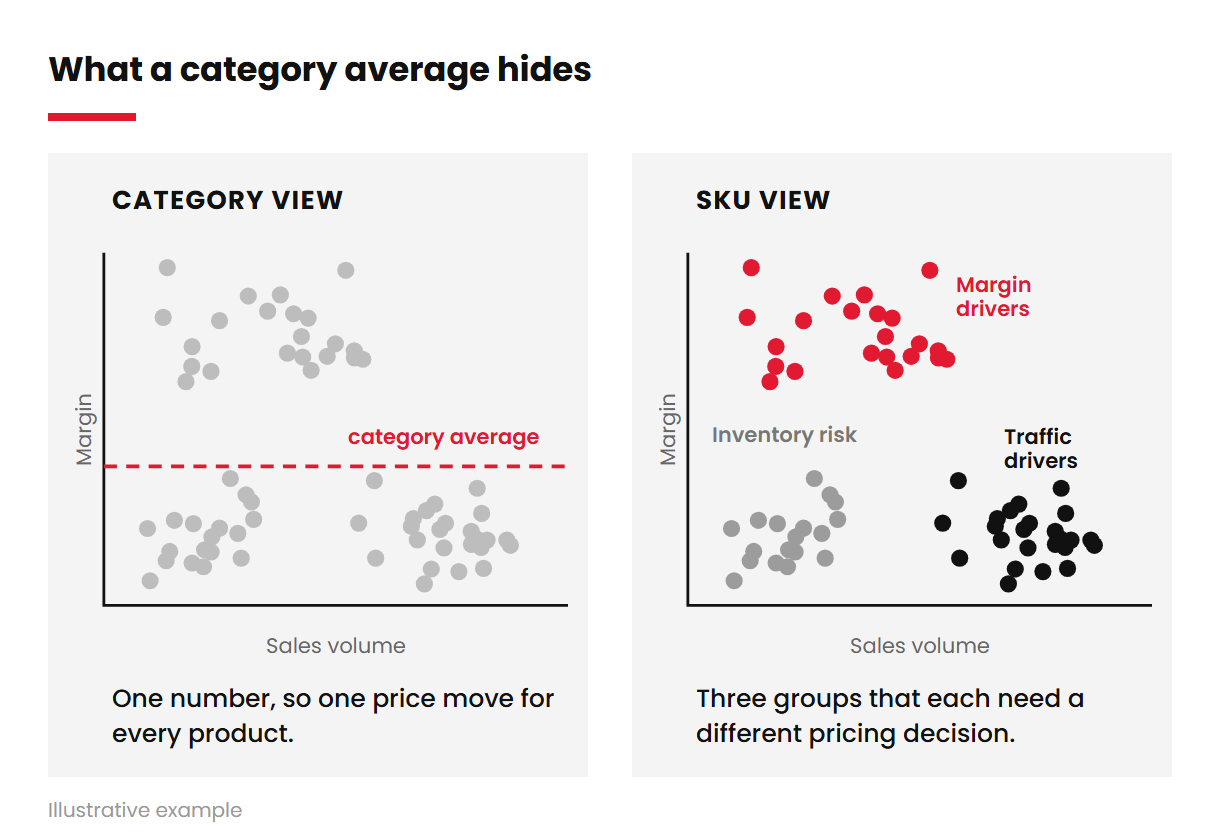
The trouble is what a group average hides. One category holds products that bring people into the store, products that earn the margin, and products that are piling up in the warehouse. Treat them as one and every price move has a side effect. An increase meant to lift margin lands on the traffic drivers too, and visits fall. A category-wide discount also cuts the price of the premium line, which was selling at full price. A team watching margin may miss stock building up until the season is over.
Rules also drift toward the safe choice. A wrong price is visible and a missed opportunity is not, so the easiest decision in September is to repeat the prices from last September, even if the market has changed since.
The work is fragmented as well. Several people each price their own categories and meet afterward to align. When a campaign underperforms, it is hard to say whether the cause was one manager's decision or two product lines taking sales from each other.
The Building Blocks of Retail Price Optimization
A model-based approach replaces the category rule with a chain of smaller steps, each of which can be inspected.
The first step is segmentation by selling behavior. Sales, inventory and cost data are processed to give each SKU a role: margin driver, traffic driver or inventory risk. Segments are recalculated as new sales and price changes come in, so a product that earned margin in spring can turn up as an inventory risk in fall.
The second step is a pair of models. A demand model forecasts how much of a product will sell, and an elasticity model estimates how that volume reacts when the price moves. Price elasticity of demand is the percentage change in quantity demanded divided by the percentage change in price. A premium item can be price inelastic. It sells about as well at full price, so discounting it gives margin away. Other products respond strongly to a modest cut.
With both models in place, the system tests several candidate prices for every product and scores the forecast outcome of each against the campaign objective. That objective is a business choice. A campaign, meaning a set of prices for a chosen group of products over an upcoming period, runs under one primary goal: a balanced result, revenue growth, margin, or inventory reduction. The other measures keep some weight, and the primary goal gets the most.
The last block is rules and limits. The team sets how far discounts and price increases may go in a campaign, and the organization keeps global rules such as a minimum margin. A simulated price that would break one is never recommended. A sensible setup warns when a limit contradicts the objective, for instance a high margin target in a campaign meant to clear stock.
Pricing New Products Without Sales History
All of this depends on history, and a new product has none. Data scientists call this the cold start problem. In a rule-based process the new SKU is filed under the nearest general category and priced like the other items there, or its launch price is copied from a competitor who may be pursuing a different goal.
Take a waterproof running shoe filed under a general category for men's running shoes. When that category is discounted, a product in high demand is discounted too, although it might have sold at full price.
The model-based answer is to match each new SKU to similar products the retailer already sells. The matching reads specifications and descriptions and can add image recognition, so that color and shape count along with details such as cushioning or sole height. The new product then inherits the pricing behavior of its closest relatives, and its launch price rests on the retailer's own sales data.
The same similarity analysis has a second use. Two product families that share a specification and a function are likely to take sales from each other. That is a range question as much as a pricing one, which is why it sits close to assortment optimization with AI.
Rules-Based vs. Model-Based Pricing
The two approaches differ in where the decision is made and in how much of it can be checked afterward.
| Area | Rules-based pricing | Model-based pricing |
|---|---|---|
| Level of decision | Category or price group, one move for all items | Individual SKU, grouped by selling behavior |
| New products | Priced like the general category or like a competitor | Matched to similar products that have sales history |
| Objectives | Implicit and different for each manager | One stated objective for each campaign |
| Control | Manual checks of as many prices as time allows | Limits set before the run, uncertain cases sent to a person |
| Accountability | Hard to trace who set a price and why | Each price has its reasoning and an approval record |
| Measuring the effect | Comparison with last year's results | A/B test against a manually priced control group |
Rules still exist in the right-hand column. Margin floors and discount caps stay, and a model applies them to every price without exception. How the pieces fit together in a working solution is described on our page about AI pricing optimization for large assortments.
Keeping People in Control
Merchandisers tend to distrust automated pricing, and their reasons are sound. They are asked to hand prices to a calculation they cannot inspect, with no assurance that it will respect the limits they work within.
A manager's usual reaction makes things worse. The team is asked to double-check every generated price, so no time is saved, and people conclude that the automation is not worth having.
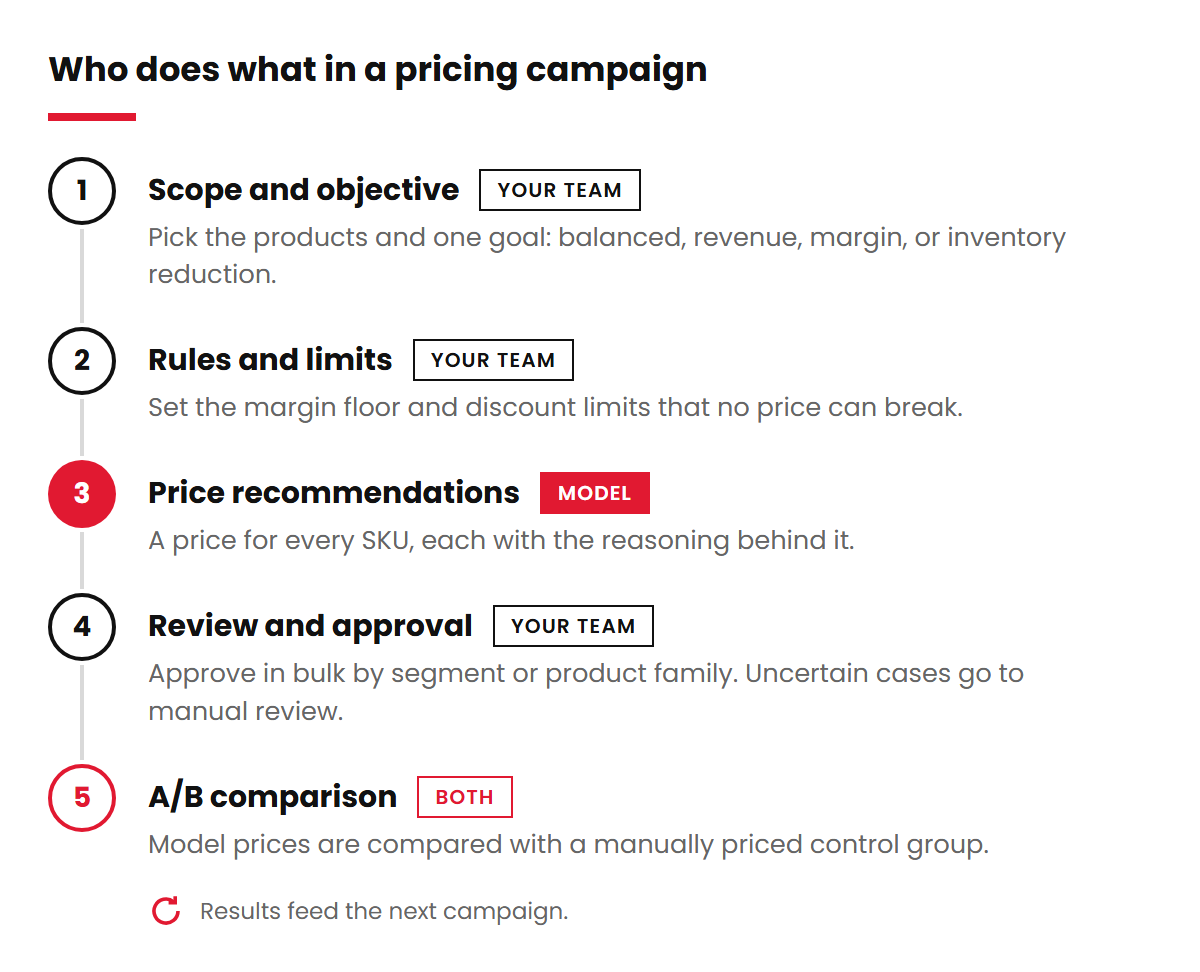
A workable division of labor looks different. The pricing team picks the scope and the objective and sets the limits. The model simulates and recommends, and each recommendation carries its reasoning in plain terms, for example high seasonal demand combined with low stock. Results can be viewed by SKU, by product family or by segment, and a whole segment can be approved in one step.
The model also has to know when to stop. Where the inputs are inconsistent or the model is unsure of a price, the decision goes to a person. Every approval and override is recorded, so when a campaign goes badly the team can see whether a price came from the model or from a person. Retail price optimization run this way gives back the accountability that a fragmented manual process loses.
How to Start with Retail Price Optimization
The usual objection to starting retail price optimization is data quality. A more useful test is completeness, meaning that the data the chosen objective depends on is there. Sales history is the one input nothing can replace, and inventory data becomes mandatory when the goal is to reduce stock. Gaps are normal. History may exist only as periodic snapshots, or costs may not be tied to individual SKUs. Such data can be reconstructed before modeling.
A first project can follow five steps:
- Pick one category with enough sales history and a pricing manager who owns it.
- Write down the objective and the rules that prices must respect.
- Run a simulation and have people who know the category review the recommendations.
- Run the campaign as an A/B test, with a control group that stays on manual pricing.
- Compare the two groups on margin and revenue, and only then decide whether to extend the approach to more categories.
The control group is what makes the result credible inside the company. The model is compared with the team's own practice in the same period, so a good or bad season affects both groups alike.
One more decision is whether to buy a packaged tool or have a solution built around your data. Packaged tools assume a clean data model and a standard process. The more reconstruction your history needs, and the more particular your rules and approval process are, the stronger the case for building.
We walked through this flow in a live session on September 30, 2026, and the recording of our Pricing at Scale webinar shows each step on screen. If you would like a second opinion on where your own pricing process loses the most time or margin, talk to the DS Stream team about your pricing setup.
Frequently Asked Questions
What is the difference between price optimization and dynamic pricing?
Retail price optimization is the broader discipline of choosing prices for an assortment against a business objective and within rules. Dynamic pricing refers to prices that change frequently and automatically in response to demand or competitor moves. A retailer can optimize prices in planned campaigns, for a season or a promotion period, without changing them continuously.
What data does retail price optimization require?
Sales history at SKU level is the minimum. Inventory data is needed when stock reduction is one of the goals. Product specifications and images help with pricing new products, and competitor prices improve the forecasts. Incomplete history can often be reconstructed before modeling.
Where should a retailer start?
With one category and a test. Choose a category with solid sales history and agree on the objective and the limits. Then run a campaign in which part of the products keep manual prices as a control group.
Does AI replace the pricing team?
No. In retail price optimization the team sets the objective and the limits, including rules that no recommendation may break. The model does the part that people cannot do at this scale, which is evaluating price scenarios for tens of thousands of products. Managers approve results in bulk and can override any price.

