AI Pricing Optimization for Retailers Managing 50,000+ SKUs
AI pricing optimization for retailers with 50,000+ SKUs. Protect margin and clear inventory with SKU-level price recommendations your team controls.

Make the right pricing decision for every product, with margin, revenue, traffic, and inventory managed together under your business rules.
- SKU segments based on selling behavior, refreshed as your data changes
- Launch prices for new products, based on comparable items you already sell
- Pricing campaigns run under one objective and your margin and discount rules
- Recommendations that show the reasoning behind each price
- A/B tests against a manually priced control group


Why Pricing Breaks Down Across Tens of Thousands of SKUs
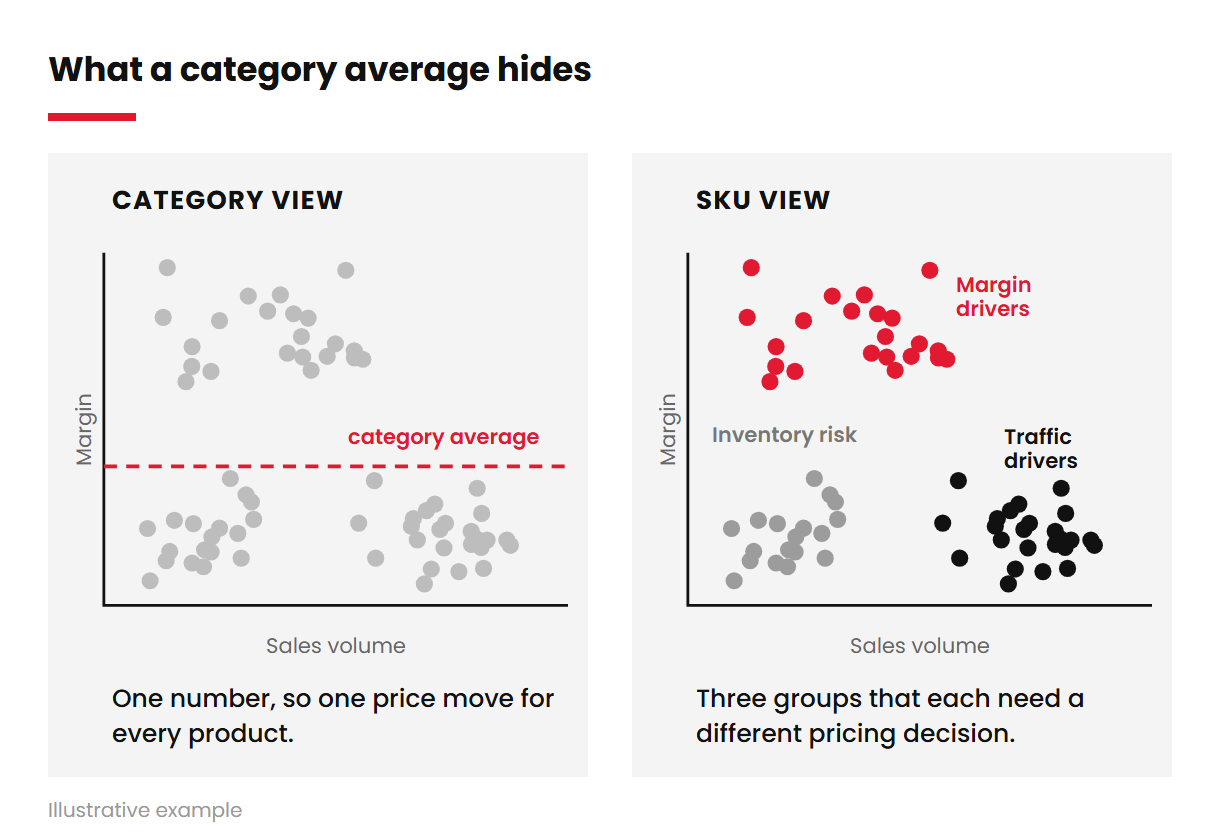
A team can price a few hundred products by hand. At 50,000+ SKUs nobody can check every item, so products get grouped by experience and managed through category averages. Those averages hide which products bring traffic, which carry margin, and which are building up stock. Prices then repeat last year's pattern because it feels safe.
Architecture Behind AI Pricing Optimization
We connect sales, inventory, and cost data with external signals such as competitor prices and promotions. Where history is incomplete or inconsistent in granularity, we reconstruct it.
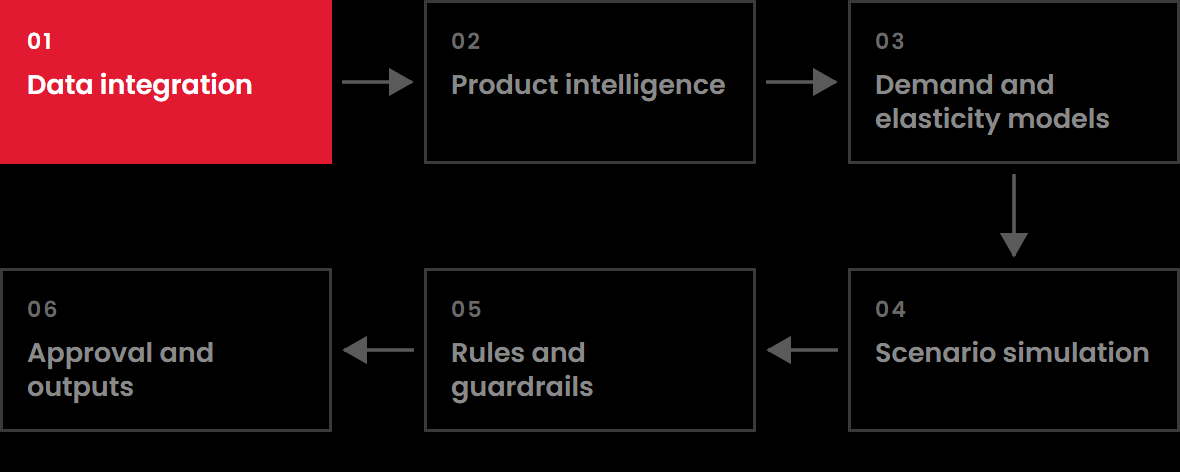
Product specifications, descriptions, and images group SKUs into families of similar products. New items are linked to siblings that already have sales history.
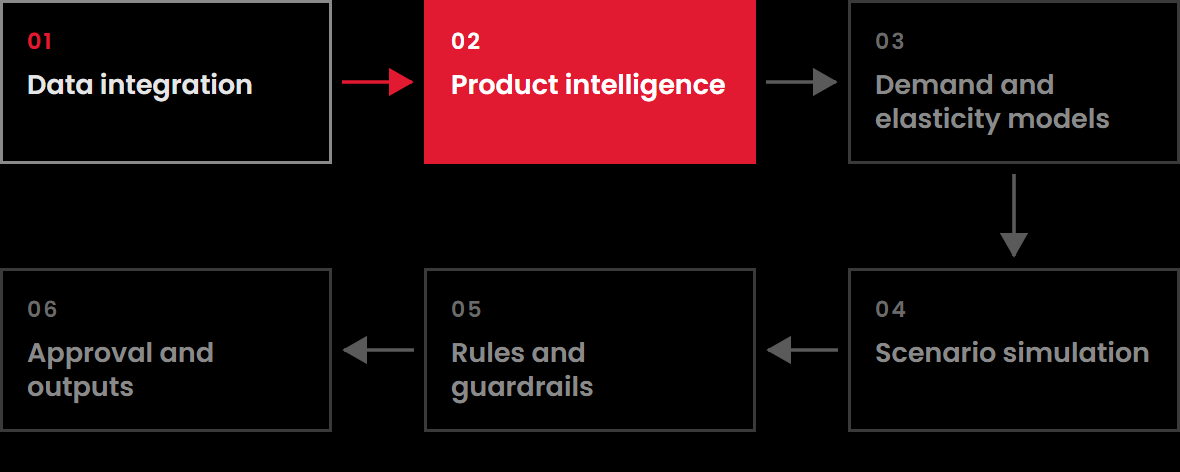
Models predict how demand for each SKU responds to a price change. They separate price-inelastic products from those where a lower price moves volume.
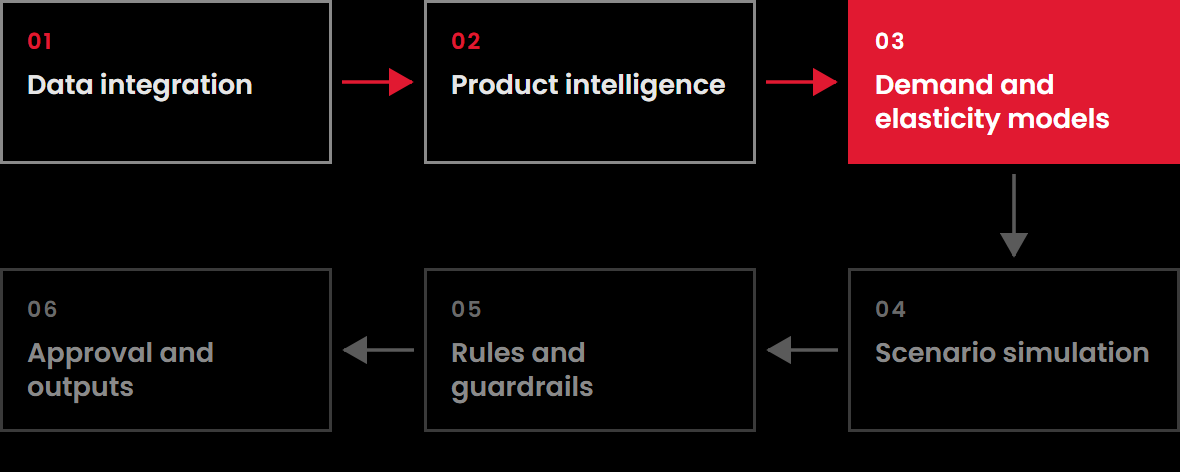
The solution tests several price scenarios for every product and scores each one against the campaign objective. It then selects the best price move the rules allow.
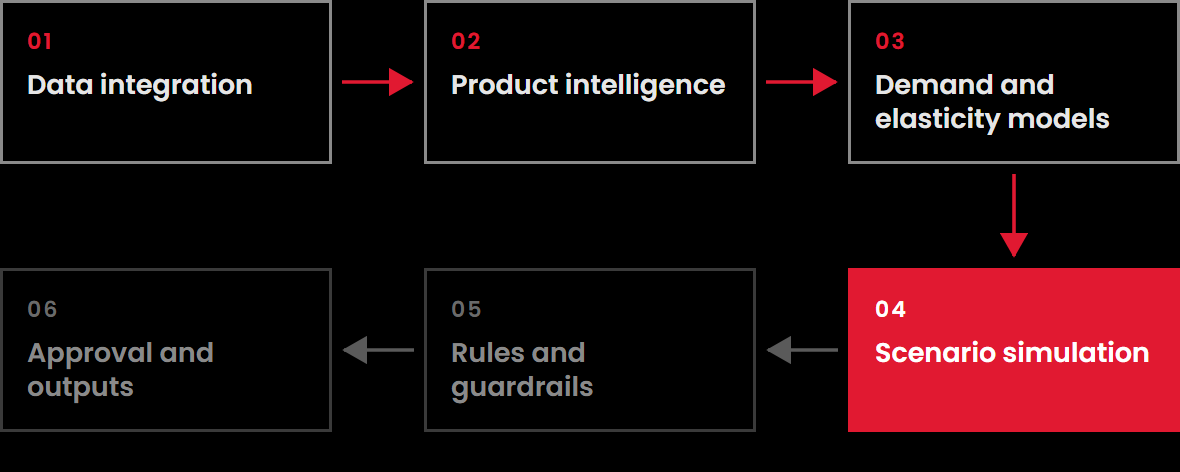
The business sets margin floors and maximum discounts as global rules. They apply to every scenario, so a simulated price cannot break them.
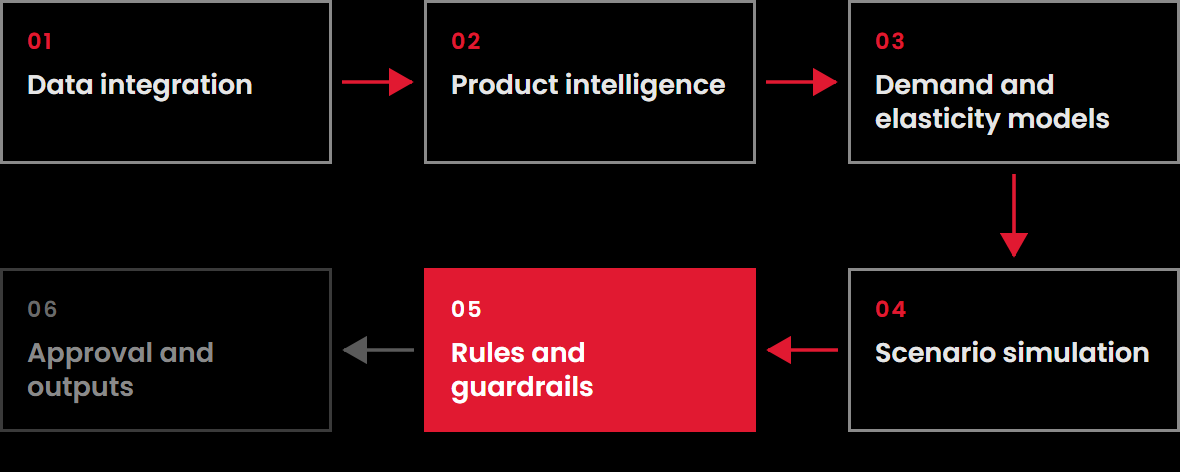
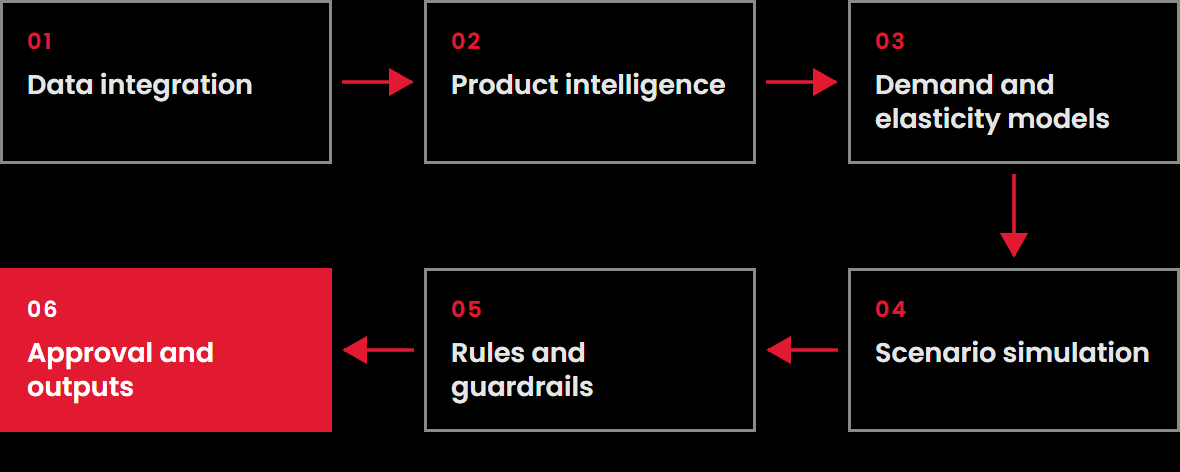
Recommendations go to pricing managers for bulk approval or manual review, and every decision is recorded. Approved prices feed ERP, BI, and repricing pipelines.
How It Works
We review the data behind your pricing, starting with sales history, and check what is missing or inconsistent. With your pricing team we write down the rules the solution must follow, such as margin floors and discount limits, and agree how prices get approved.
We train demand and price elasticity models on your data and build the product families used to price new SKUs. Gaps in the history are reconstructed first, so the models learn from a consistent data set.
We run price scenarios for each product under your rules and go through the recommendations with your team. People who know the assortment check whether the suggested prices and their explanations make sense.
One category runs on recommended prices while a control group stays on manual pricing. The A/B comparison shows how the approach performs on your products before you commit to more.
We extend the solution to further categories and connect its outputs to your ERP and BI systems or to a repricing pipeline. Segments are recalculated as new sales data comes in.
Business Impact
Higher margin from prices set per SKU instead of category-wide discounts
Faster inventory turnover through markdowns aimed at the products that need them
Less capital tied up in aged stock because inventory risk shows up at SKU level before it grows
Consistent pricing rules in every campaign, with margin floors and discount limits set by the business
Decisions in minutes instead of days when managers review and approve price changes in bulk
Who This Is For


What We Deliver
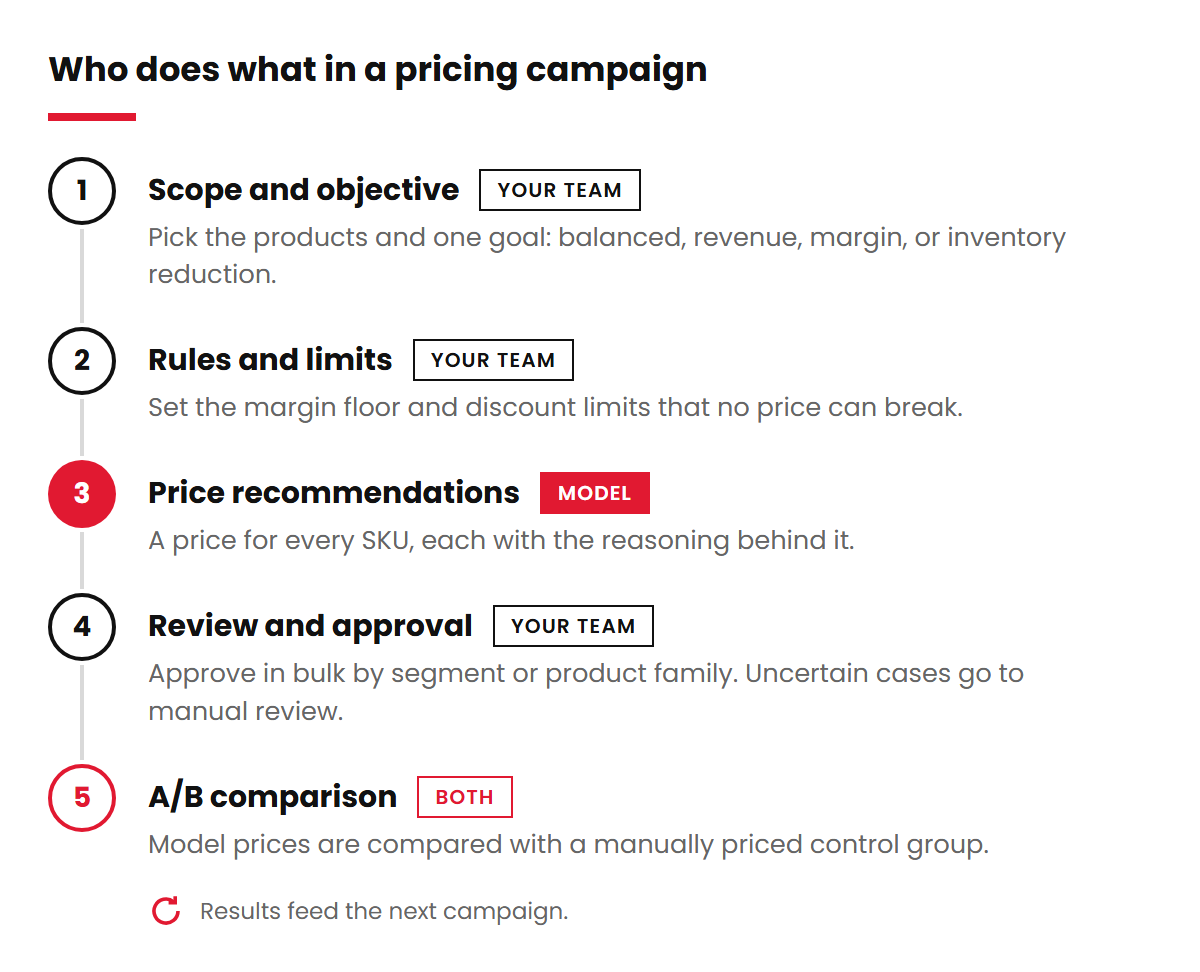
A pricing solution built on your data and your business rules. Models recommend a price for each SKU and show the reasoning. Your pricing and category managers set the objective and the limits, then approve or override the result.
Frequently Asked Questions
No. The data has to be complete, but it does not have to be perfect. Sales history is the one input we cannot work without, and inventory data is required if you want to optimize for stock. Where history has gaps or comes at inconsistent granularity, we reconstruct it before training the models.
We match each new SKU to sibling products you already sell. The matching reads specifications and descriptions and adds image recognition, so a new item is grouped with products that share its features and look. It then inherits their pricing behavior, and the launch price reflects your own sales data as well as what competitors charge.
You set the rules and you approve the prices. Before a campaign runs, your team defines the objective and the limits, plus global rules such as a margin floor that no recommendation can break. Each price comes with its reasoning. Uncertain cases go to manual approval, and the history shows who accepted or overrode a decision.
You test them against your own pricing. In a campaign you can hold back a group of SKUs and keep pricing them manually while the rest follow the recommendations. After the campaign you compare the two groups on margin and revenue. The comparison runs on your products, so it tells you whether to extend the approach.
Yes. Segments are recalculated as new data comes in. Pipelines reprocess the portfolio after new sales and price changes, so a product can move from one segment to another when its sales or stock change. The segment view always shows the current state of your assortment.
Yes, and we configure this for each client. A campaign has a product scope and one primary objective, so summer stock can run under an inventory reduction goal in its own campaign. Mixing objectives and rules for several groups inside a single campaign is not part of the standard flow. We build it when your process requires it.
Because off-the-shelf tools assume data and processes you may not have. Gaps in sales history and costs that are not tied to individual SKUs need reconstruction work that a packaged product does not do. Your pricing rules and approval process need configuring too. We build the solution around them, then prove it on one category before a full rollout.
Discuss Your Pricing Challenges with Our Team
Book a free consultation with the DS Stream pricing team. There is no obligation. We talk through your assortment and your data, and look at where pricing takes your team the most effort. DS Stream is a team of 200+ experts in data, AI, machine learning, and software engineering.
Consultation call
We talk through how you set prices today and which goals pricing has to serve.
Category and data check
We pick one category together and confirm that the historical data needed for modeling is available.
Simulation and pilot
We run a price simulation on that category and, if the results hold up, move to a pilot.