
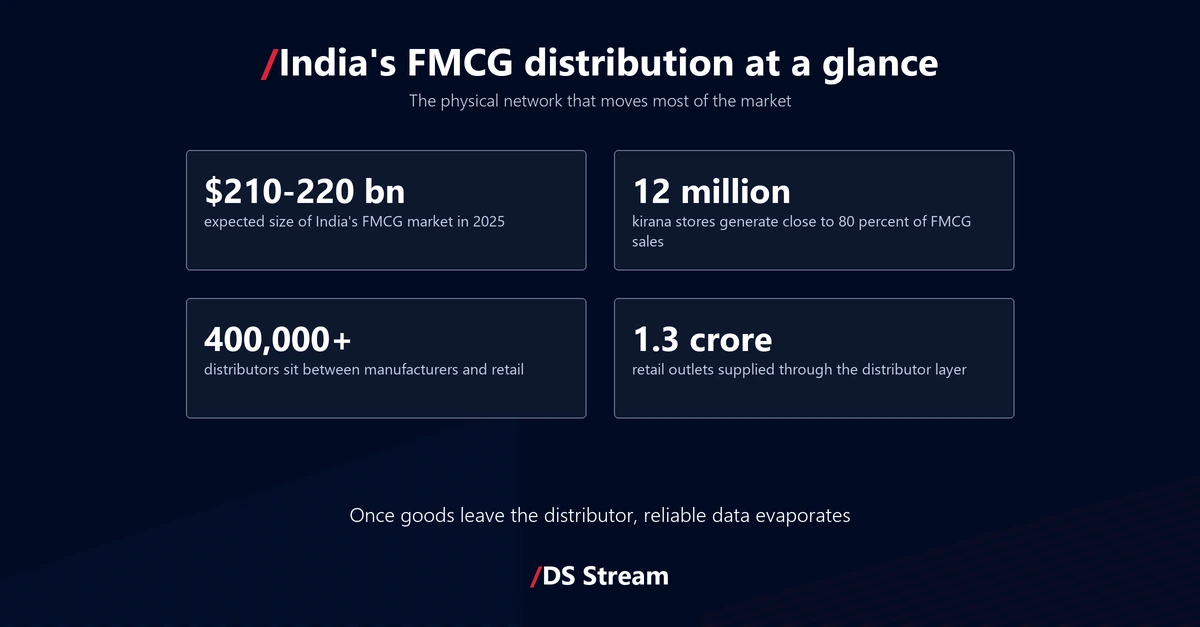
India's fast moving consumer goods market is expected to be worth somewhere between 210 and 220 billion dollars in 2025, yet almost all of that value still moves through a physical network of remarkable size. Roughly 12 million kirana stores generate close to 80 percent of FMCG sales, and they are supplied by more than 400,000 distributors sitting between manufacturers and about 1.3 crore retail outlets. The model has worked for decades. It also conceals much of what a brand needs to see. The moment goods leave a distributor's warehouse, reliable information about what sold, to which shop, and at what price tends to evaporate.
Closing the Secondary Sales Blind Spot
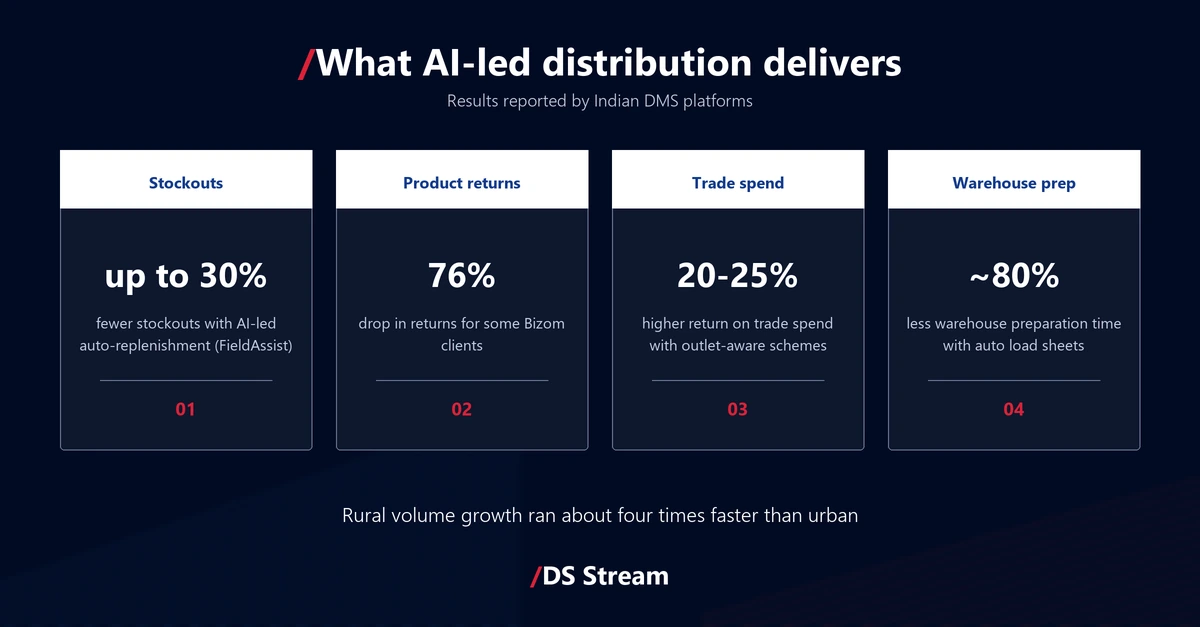
Brands track primary sales, the stock they push into the distributor, down to the case. Secondary sales, the flow from distributor to retailer, is where the picture blurs. For years the industry filled that gap with distributor self-reporting and monthly claims that arrived late and were hard to trust. The blind spot drives overstocking on some routes and stockouts on others, often at the same time, and it makes national demand planning a guessing game. AI changes the economics of visibility. When distributor management and sales force automation data is fed into a forecasting model, brands can build outlet-level demand estimates that account for promotions, seasonality, festival spikes and each distributor's current inventory position. FieldAssist, whose platform tracks close to 8.9 million outlets and 75,000 distributors, reports that AI-led auto-replenishment logic cuts stockouts by up to 30 percent. Bizom, covering around 8 million outlets and roughly half a billion dollars in monthly orders, links similar tooling to a 76 percent drop in product returns for some of its clients.
Forecasting That Reflects What Shops Actually Buy
Demand planning in India is unusually hard because demand is unusually local. A district's buying pattern shifts with harvest cycles, regional festivals, weather and a price sensitivity that can vary street by street. NielsenIQ data for early 2025 showed rural volume growth running about four times faster than urban, which means a national forecast built on last year's averages will miss badly in exactly the markets that are now expanding. Machine learning models trained on granular secondary sales history read these local signals far better than spreadsheets or gut feel. The payoff is practical rather than theoretical: fewer expiring SKUs on distributor shelves, higher fill rates for retailers, and trade promotion budgets aimed where they convert instead of sprayed evenly across a territory. FieldAssist attributes 20 to 25 percent higher return on trade spend to dynamic, outlet-aware scheme budgeting, and its auto-generated load sheets cut warehouse preparation time by around 80 percent.
Inventory, Credit and the Working Capital Squeeze
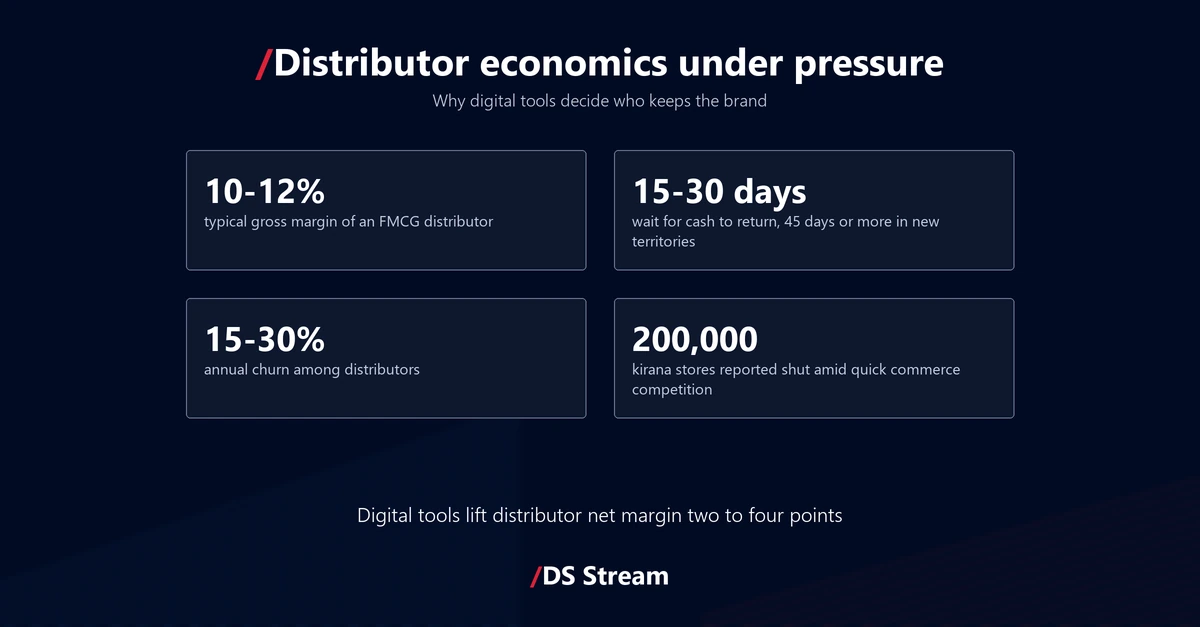
Distribution in India runs on thin margins and stretched credit. A typical FMCG distributor works on a 10 to 12 percent gross margin and often waits 15 to 30 days for cash to return, sometimes 45 days or more in newer territories. When retailers facing weaker footfall delay payment, the strain lands on the distributor first. AI helps on both sides of that squeeze. Replenishment models keep less capital locked in slow-moving stock, while credit scoring built on order frequency, payment behaviour and route data flags which retailers are drifting toward default before the exposure grows. That lets a distributor extend credit with more confidence to dependable outlets and tighten it selectively, rather than applying one blunt policy to every shop on the beat. The same order and payment signals also tell a brand which distributors are financially healthy enough to take on a new range and which are already overextended, a judgment that used to rest on relationships and instinct alone.
Order Automation and Distributor ROI
The clearest proof that this works sits inside Hindustan Unilever. Its Shikhar eB2B app now serves more than 1.4 million retailers and contributes over a third of the company's sales, letting kirana owners reorder on their phones with AI-assisted suggestions instead of waiting for a salesperson's weekly visit. For the distributor, app-based ordering, real-time stock visibility and instant confirmation lower the cost of serving each store and free field staff for higher-value selling. This matters because distributor economics are under genuine pressure. Churn among distributors is running at 15 to 30 percent a year, and quick commerce competition has pushed general trade sales during festival periods down by 25 to 30 percent in some estimates, with roughly 200,000 kirana stores reported to have shut. Distributors without digital tools are steadily losing brand appointments to those who have them. Technology adoption, by several industry estimates, lifts a distributor's net margin by two to four percentage points, which on such a low base is the difference between a viable business and an exit.
None of this requires tearing out the human network that makes Indian distribution work. The salesman, the distributor's local knowledge and the kirana relationship remain the core of the system. What AI adds is a layer of sight and prediction on top of an operation that has always run partly on instinct. The brands pulling ahead are the ones treating secondary sales data as a strategic asset rather than a reporting afterthought, and wiring their DMS, SFA and forecasting into a single loop that keeps learning from what each outlet actually buys.
Getting there is less about buying another dashboard and more about building clean, connected data pipelines that a model can trust. That is the unglamorous work of integration, data quality and forecasting infrastructure, and it is where DS Stream helps FMCG and retail teams turn distribution data into decisions.
Sources
- NielsenIQ - FMCG Growth Momentum Shifts: Rural India and Small Players Take Charge
- FieldAssist - Distributor Management System
- Bizom - Distributor Management System for FMCG
- Unilever (HUL) - The future is phygital: How Shikhar is redefining retail for India's kirana stores
- Kotak - The Invisible Industry Between Factory and Your Kirana
- SpireStock - FMCG Distributor Margin and Profit Guide India
- Outlook Business - Kirana Stores Under Pressure From Q-Commerce Discounts
- Kirana Club - The Complete Guide to FMCG Distribution in India

