
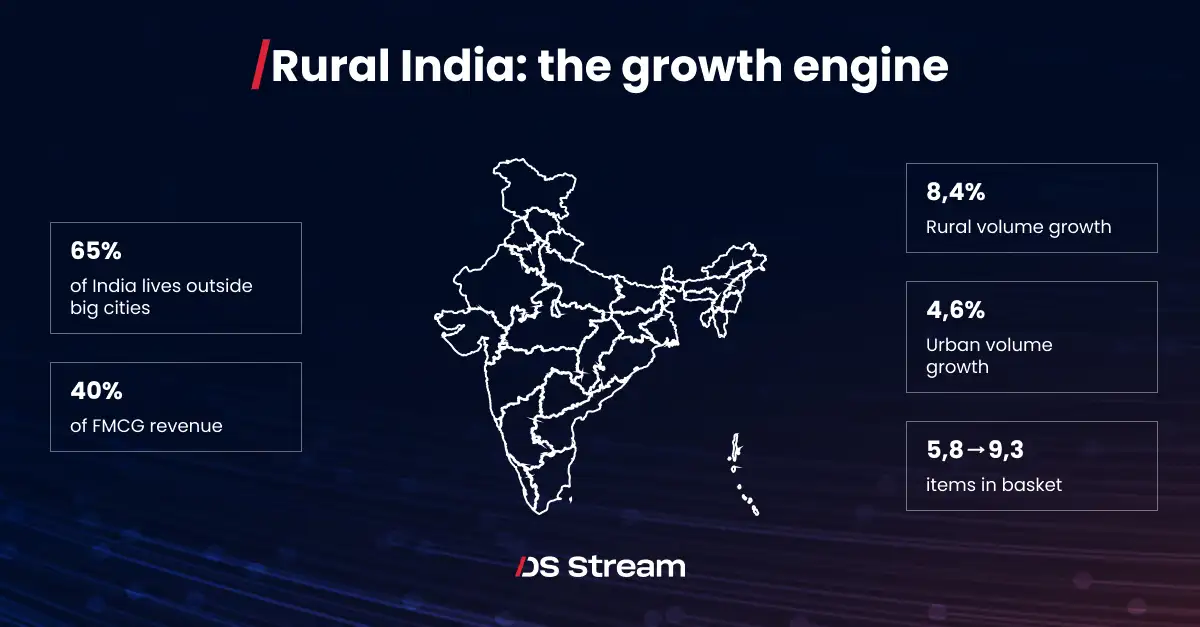
Rural India is where the growth is, and the numbers now make that hard to ignore. Roughly 65 percent of the country lives outside the big cities, and rural markets already contribute close to 40 percent of FMCG revenue. More telling is the direction of travel. NielsenIQ reported that rural volumes grew 8.4 percent against 4.6 percent in urban areas, the sixth straight quarter of rural outpacing urban, and that pattern has since stretched to eight consecutive quarters. Average rural basket sizes rose from 5.8 items in 2022 to 9.3 in 2024. The demand is real. The hard part has always been reaching it profitably.
That is the gap AI is starting to close. India has more than 600,000 villages, hundreds of thousands of unbranded kirana stores, patchy addresses and thin historical sales data. Traditional expansion meant guesswork, blanket distribution and a lot of stranded inventory. Newer approaches replace the guesswork with signals that already exist.
Where to go: scoring markets before the first visit
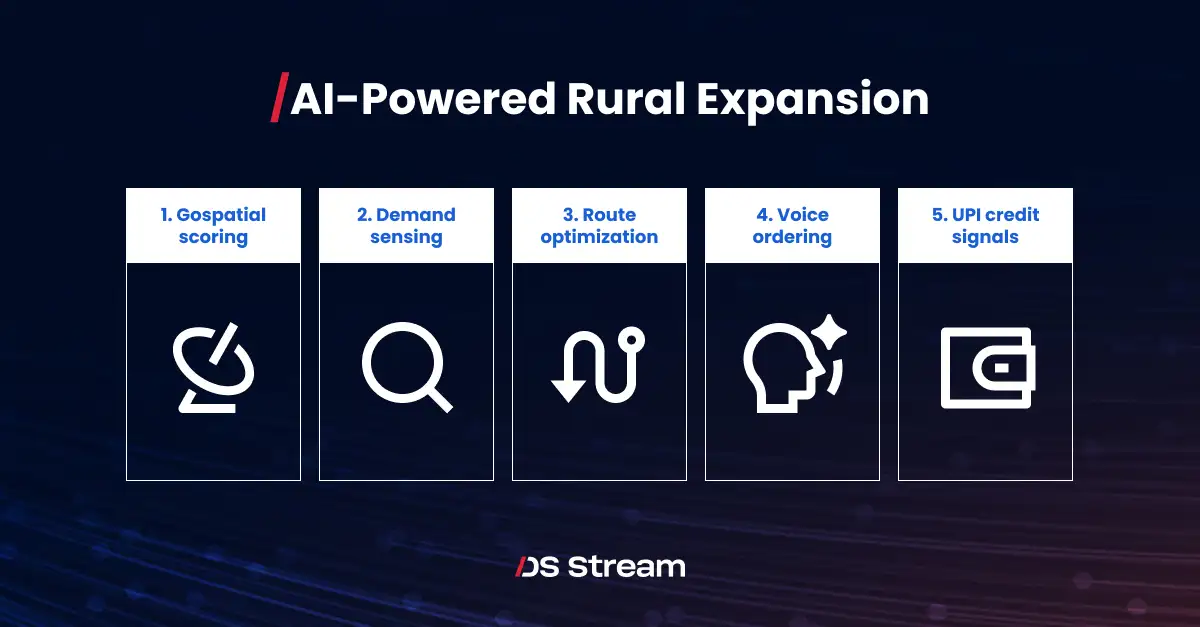
Start with where to go. Geospatial and satellite data let brands score market potential village by village before a single salesperson visits. India's geospatial analytics market is now valued above one billion dollars, and satellite imagery services are projected to grow at roughly 17 percent a year through 2031. Layered with night-light intensity, rooftop counts, road quality and crop cycles, these datasets estimate purchasing power in places where census figures lag reality. The government's move to assign unique land parcel IDs across 620,000 villages adds a spatial backbone that commercial teams can build on. The practical output is a ranked map: which clusters to enter first, where to place a distributor, which routes justify a delivery van.
Demand sensing in a low-data environment
Demand forecasting is the second shift. Rural regions are exactly the low-data environments where classic forecasting struggles, so the useful models borrow strength from elsewhere. Demand sensing blends weather, festival calendars, harvest timing, local wage cycles and mobile signals to predict what a cluster of villages will buy next month. ITC's logistics work forecasts demand spikes around festivals and crop harvests; HUL has leaned on AI-based demand sensing to keep products stocked in remote villages. The point is not perfect accuracy. It is cutting stockouts and dead inventory enough to make thin rural margins work.
Route-to-market and micro-market segmentation
Route-to-market optimisation ties the two together. Sales force automation and distributor management systems, now increasingly AI-assisted, plan beats, sequence store visits and flag underperforming outlets in real time. Dabur, which draws close to half its revenue from rural markets and reaches over 1.3 lakh villages and 1.42 million outlets, has moved to digital tracking of distributor performance rather than monthly guesswork. Micro-market segmentation goes finer still, grouping villages by language, income proxy and category preference so that the assortment sent to a cluster in western Odisha differs from one in coastal Andhra. A single national plan wastes money in a country this varied.
Vernacular voice: removing the language barrier
Language is its own barrier, and one AI is well suited to remove. Most rural buyers and many small retailers do not transact comfortably in English. Vernacular voice interfaces let a shopkeeper reorder stock, check a scheme or raise a complaint by speaking Hindi, Marathi or Tamil into a phone. Voice-first ordering also suits users who read less fluently than they speak, which widens the base of retailers a brand can serve directly without a field agent standing there.
Credit: what UPI data unlocks for the last mile
Credit may be the quietest but most consequential piece. Rural retailers have long been denied working capital because they had no formal credit history. That is changing fast. NPCI is piloting a lending interface that turns UPI transaction data into real-time credit scores, using transaction frequency, merchant category and payment success rates as signals a bank can underwrite against. Credit Line on UPI, launched in August 2025, reached roughly 11 lakh pre-qualified customers and sanctioned limits above 362 crore rupees within months. For an FMCG brand, a retailer who can suddenly access a small line of credit is a retailer who stocks deeper and pays reliably. Telecom and UPI data together sketch a picture of a shop's cash flow that no ledger book ever offered.
AI guides. People deliver.
None of this removes the need for people. HUL's Project Shakti still runs on more than 200,000 rural women entrepreneurs reaching roughly half the villages in India. The shift is that AI now tells those networks where to push, what to carry and which outlets are ready for more. Human distribution and machine intelligence are becoming complementary rather than competing answers.
The honest caveats for decision-makers
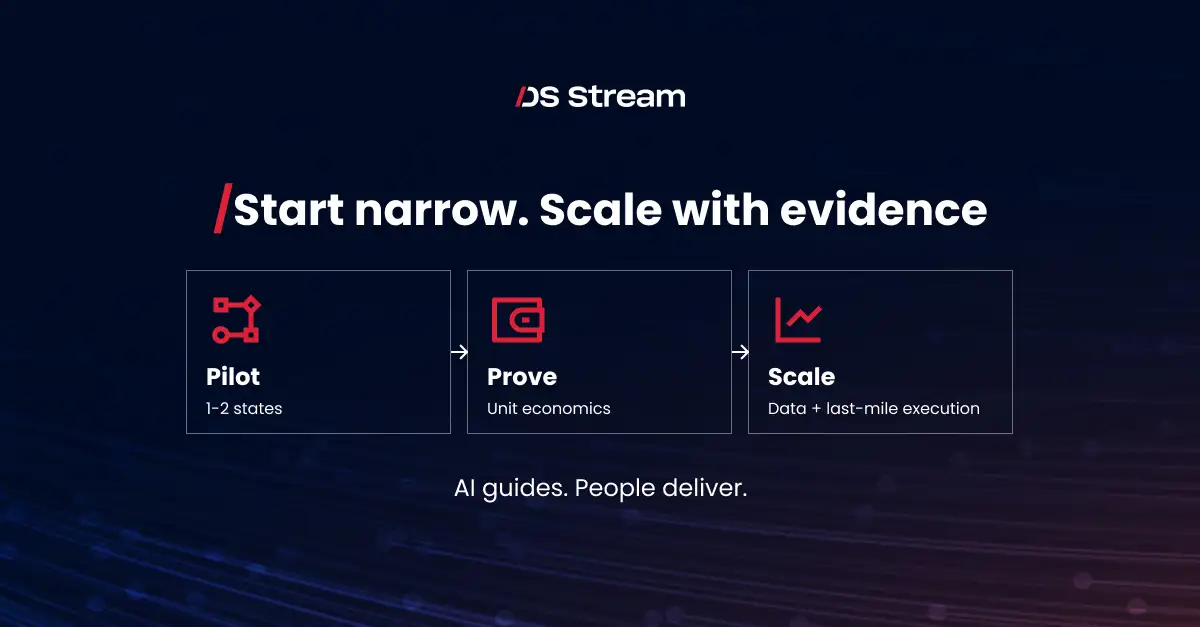
For decision-makers, the honest caveats matter. Skilled analytics talent is scarce outside major metros, data quality varies, and models trained on urban behaviour transfer badly to rural life. The teams that win treat rural expansion as an engineering problem with a human layer, not a marketing campaign. They start with one or two states, prove the unit economics, and let the data compound. Rural consumption is projected to grow near 9.7 percent a year through 2030, so the prize is patient rather than instant.
The next billion consumers are not hiding. They are spread thin across geography, language and income, and the tooling to reach them economically has finally caught up with the ambition. Brands that pair reliable data foundations with disciplined last-mile execution will own that market before their competitors finish debating it.
If you are weighing how to build the data and forecasting backbone behind a rural push, this is the kind of problem our teams at DS Stream work on with FMCG and retail clients.
Sources
- NielsenIQ - Rural Fuels India's 13.9% FMCG Growth in Q2, While Urban Recovery Gains Momentum
- IBEF - FMCG Sector prospects in the Indian Rural Market
- Mordor Intelligence - India Geospatial Analytics Market Size and Growth
- IBEF - Thriving FMCG Industry in India Driving Its Sales
- EY India - How recent changes to UPI are helping fill India's credit gap
- IBS Intelligence - FinTech 2026: Why Credit Line on UPI Will Reshape the Entire Ecosystem
- Unilever - How AI and digital tools are empowering women micro-entrepreneurs (Shakti)

