
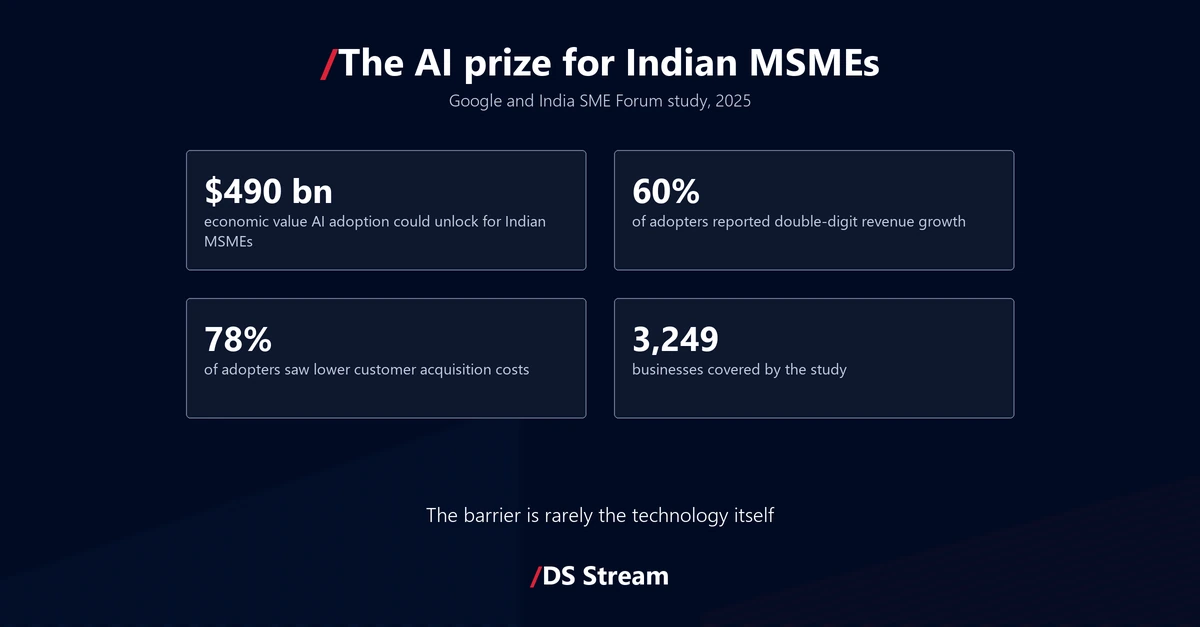
For a regional biscuit maker in Indore or a fast-growing D2C skincare brand in Bengaluru, artificial intelligence can feel like a tool built for Hindustan Unilever, not for a company running on thin margins and a lean team. That perception is costly. A 2025 study by Google and the India SME Forum, drawn from 3,249 businesses, estimated that AI adoption could unlock roughly 490 billion dollars in economic value for Indian MSMEs, with 60 percent of adopters reporting double-digit revenue growth and 78 percent seeing lower customer acquisition costs. The barrier is rarely the technology itself. It is knowing where a small budget buys the most.
Start Where the Money Leaks
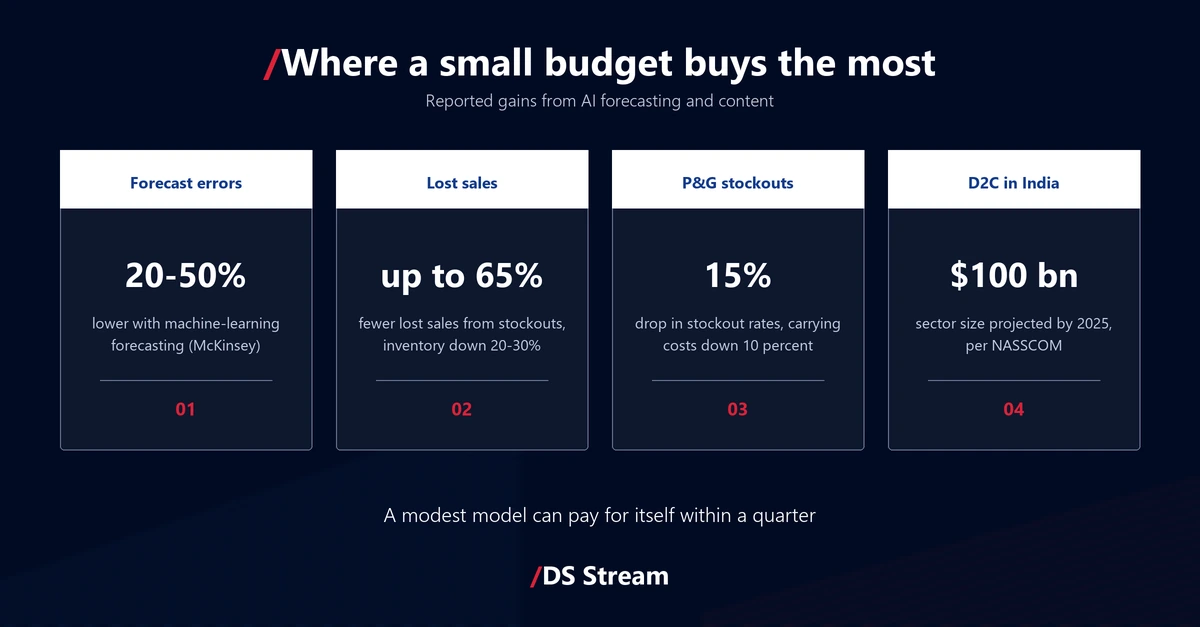
The highest-return entry point for most FMCG firms is demand forecasting. Inventory sitting in a warehouse or a distributor's godown is cash frozen in place, and a stockout on a kirana shelf hands the sale to a competitor. McKinsey research on distribution operations shows that machine-learning forecasting can cut forecast errors by 20 to 50 percent, reduce lost sales from stockouts by up to 65 percent, and lower inventory by 20 to 30 percent. Procter and Gamble reported a 15 percent drop in stockout rates and a 10 percent cut in inventory carrying costs after deploying an AI forecasting system. A mid-sized company does not need that scale to benefit. A modest model trained on two years of sales history, seasonality and local festival calendars can pay for itself within a quarter, and it runs on data the business already has.
Rent Capability Before You Build It
The instinct to hire a data science team and build everything in-house is where budgets die. For companies under a few hundred crore in revenue, the sensible default is buy and rent, not build. Cloud platforms from AWS, Microsoft Azure and Google Cloud offer forecasting, analytics and recommendation services on pay-as-you-go pricing, so a firm pays for what it uses rather than a fixed data centre. Open-source libraries such as Prophet and scikit-learn cost nothing in licences and handle most forecasting and segmentation work a growing FMCG brand will face. Off-the-shelf SaaS covers inventory optimisation and route planning without a single line of custom code. The World Economic Forum's 2025 AI playbook for India's SMEs makes the same case: cloud and managed services collapse the upfront cost that has historically kept smaller players out. Build custom only when a workflow is genuinely a competitive edge and no product serves it.
Generative AI for Content and Customer Service
The cheapest, fastest wins now sit in generative AI. Writing product descriptions for hundreds of SKUs across Amazon, Flipkart and a brand's own store used to consume weeks of agency time. A tool like ChatGPT or an equivalent, guided by a good brief and human editing, drafts that catalogue in days. NASSCOM has described generative AI as a catalyst for India's direct-to-consumer sector, which was projected to reach 100 billion dollars by 2025, roughly thirteen times its 2020 size. On the service side, WhatsApp is where Indian shoppers already are. An AI assistant handling order status, returns and simple product questions in Hindi, Tamil or Marathi deflects a large share of support tickets at a fraction of a call-centre's cost. The guardrail matters: generative models can invent claims or lift copy, so a person should review anything that touches regulated ingredient or health messaging before it goes live.
Get the Data House in Order First
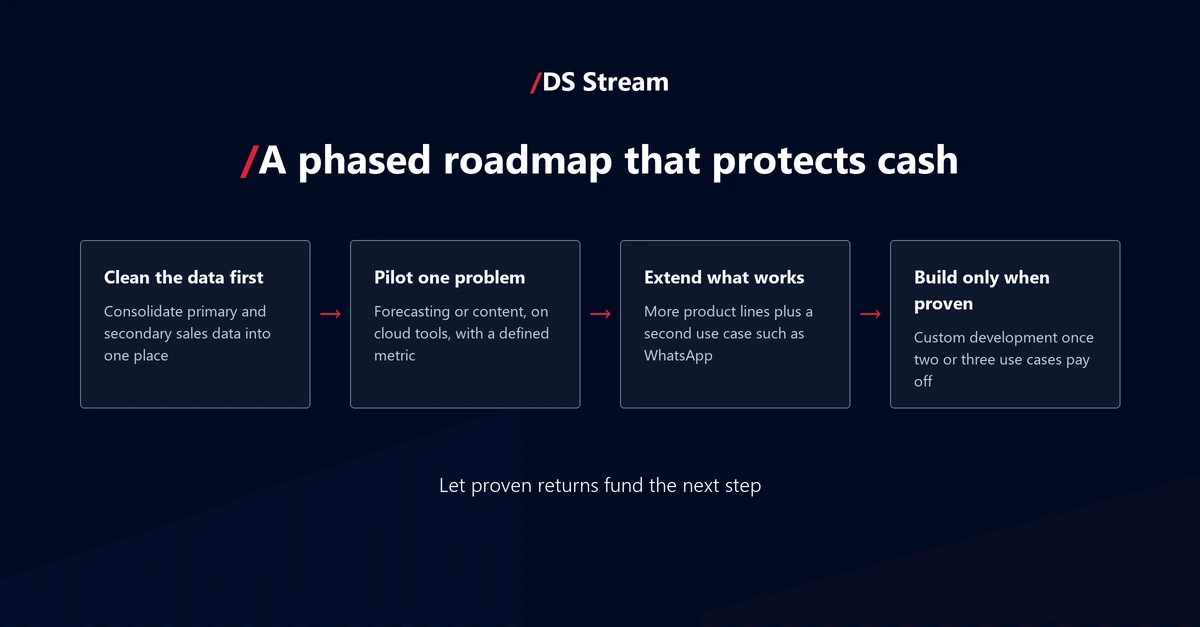
None of this works on messy data. Many FMCG SMBs still run on spreadsheets, disconnected billing software and a distributor network that reports sales weeks late. A forecasting model fed inconsistent SKU codes and missing dates will produce confident nonsense. Before spending on models, spend a few weeks cleaning and consolidating primary and secondary sales data into one place. This groundwork is unglamorous and it is the single biggest determinant of whether an AI project earns its keep. It also costs little beyond staff time.
A Phased Roadmap That Protects Cash
Treat adoption as a sequence, not a leap. In the first quarter, pick one painful, measurable problem, usually forecasting or content, and run a small pilot on existing cloud tools with a defined success metric such as forecast accuracy or stockout rate. If it clears the bar, extend it to more product lines and add a second use case, perhaps WhatsApp support or promotion planning. Only in a later phase, once two or three use cases are proven and the data foundation is solid, does custom development or a dedicated analytics hire make financial sense. Early AI integration has been linked to operational cost reductions of 20 to 30 percent, but those gains accrue to firms that stage their spending against results rather than committing large sums on faith.
Where Budgets Get Wasted
The common failure modes are predictable. Buying an enterprise platform sized for a company ten times larger. Launching a flashy chatbot with no clean product data behind it. Chasing a custom model when an off-the-shelf API would do. Surveys of Indian MSMEs reflect the caution behind these mistakes, with 68 percent finding initial AI costs prohibitive and 59 percent citing budget limits as the main obstacle. The answer is not to spend more. It is to start narrow, measure honestly, and let proven returns fund the next step. The government's 1.15 billion dollar IndiaAI Mission and a widening pool of affordable cloud services mean the entry cost keeps falling.
The firms that win with AI over the next few years will not be the ones that spent the most. They will be the ones that picked the right first problem, kept their data clean, and expanded only what worked. If you want a second pair of eyes on where AI would earn its keep in your operation, that is a conversation worth having before you write the cheque.
Sources
- Adgully - AI Adoption by Indian MSMEs projected to unlock over $490 billion in economic value: Google Report
- McKinsey & Company - Harnessing the power of AI in distribution operations
- World Economic Forum - Transforming Small Businesses: An AI Playbook for India's SMEs
- PwC India - Unlocking the AI Edge for MSMEs
- EY and NASSCOM - The NASSCOM AI Adoption Index: Tracking India's Sectoral Progress on AI Adoption
- NASSCOM Community - Generative AI, a new catalyst for D2C expansion
- FieldAssist - AI Inventory Management: Smarter Stock Optimization for FMCG

