
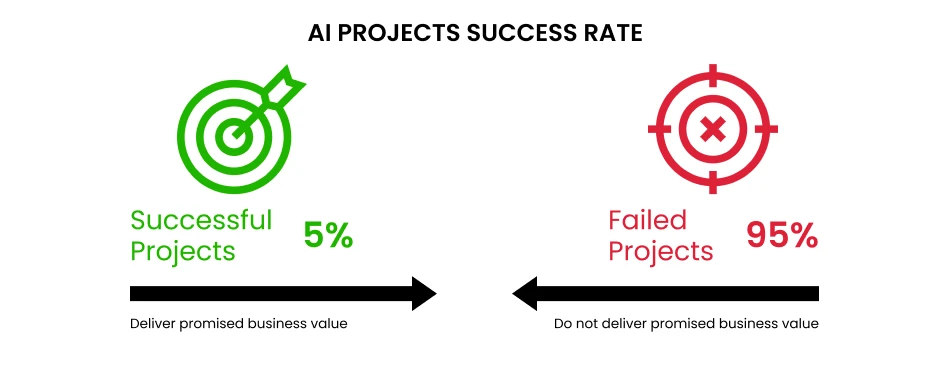
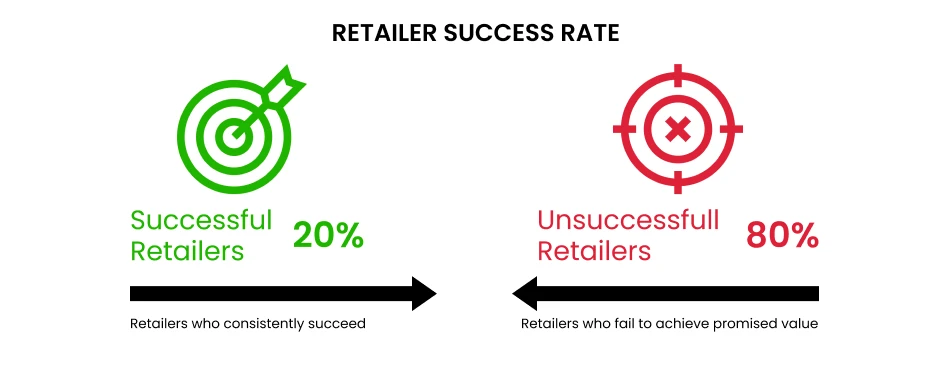
AI failure statistics are often quoted to scare executives,but the real issue is simpler: most AI initiatives in retail never deliver the business value they promise. This article explains why AI projects fail in retail and what leading retailers do differently to be in the successful 5–20%.
Why So Many AI Projects Fail in Retail
Lack of Clear, CFO-Level Business Outcomes
One of the biggest reasons AI projects fail in retail is how they start. Many initiatives begin with vague ambitions such as “we need AI in demand forecasting” or “we should do something with AI”.
Without a clear, measurable business outcome expressed in CFO language, teams do not know what success looks like and stake holders quickly conclude that “AI didn’t work”.
Examples of concrete goals:
- Reduce out-of-stocks on the top 1,000 SKUs by 20%.
- Cut inventory by 10% in a specific category without hurting availability.
When this kind of target is missing, even technically strong models are perceived as failures because they do not clearly move the P&L.
Choosing Flashy AI Use Cases Instead of High-Value Problems
Another frequent mistake is choosing use cases because they look impressive on slides rather than because they are the biggest profit levers. Vision-based shelf analysis or chatbots may be eye-catching, but a lot of real money sits in less glamorous areas such as back-office automation,better demand forecasting, smarter assortment decisions and more disciplined price and promotion management.
If AI is deployed in marginal processes, it can work technically and still be dismissed as a failure simply because it does not change core business metrics.
Weak Data Foundations and Fragmented Retail Systems
AI needs consistent, integrated data. Many retailers,however, run separate systems for POS, e-commerce, loyalty, ERP, warehouse and marketing – each with its own identifiers and definitions.
Typical symptoms include a lack of unified product, customer or store views and inconsistent history of sales and prices. In such an environment, even the best model will struggle once it meets messy omnichannel data. Retailers do not need a perfect data platform to begin, but they do need a minimal, reliable backbone instead of pure chaos.
Focusing on Models, Not Adoption and Change Management
Even when the technical work is strong, AI projects often fail at the moment of adoption. The model is deployed, dashboards look impressive – and the business continues to operate as before.
Buyers and category managers may distrust recommendations,find tools too complex or lack incentives to change decisions. In this situation AI becomes an expensive reporting layer: something you can show in a presentation, but not a real decision engine.
Treating AI as a Series of One-Off Experiments
Many retailers run AI as disconnected pilots: a proof of concept here, a vendor project there, a local experiment in one department.There is no long-term roadmap, no reusable components and no clear product owner.
Over time, each initiative slows down or dies once the original sponsor moves on, and leadership concludes that AI “never really landed”.
How Successful Retailers Make AI Projects Work
Retailers that consistently end up in the successful 5–20%treat AI not as magic but as an execution discipline.
Start with One Sharp Business Question
Instead of starting from technology, successful retailers begin with a focused business question:
“Which decision, if we made it 20–30% better, would create the most value for our business this year?”
This could be reducing markdowns in fashion without hurting sell-through, making assortments more local without exploding operational complexity, or improving the effectiveness of promotions in a few strategic categories. From this starting point they define baseline, target, scope and time horizon so that success or failure is no longer a matter of opinion.
Pick Pragmatic, High-Impact First Use Cases
Winning retailers are pragmatic about where to begin. The first AI use case has meaningful impact but is technically and organizationally feasible – for example demand forecasting for selected categories and stores,assortment optimization in one segment or automated ordering for part of the network.
They avoid highly political, group-wide topics as a first experiment. Credible early wins build trust and budget for scaling.
Build Data Foundations and AI Models in Parallel
Instead of spending years on abstract data-platform projects, successful retailers work on data foundations and AI models in parallel. They focus on unifying key identifiers, making historical sales and promotion data accessible and defining basic data ownership. Early AI use cases then reveal where gaps really hurt, and those are fixed first. Every improvement in data quality is tied directly to visible business impact.
Design AI Around Real Retail Workflows
Another differentiator is how AI is delivered to users. In successful projects, recommendations are embedded directly into tools that buyers, planners and managers already work with.
Outputs are presented as clear, actionable suggestions –such as “increase stock here by X”, “remove these SKUs” or “add this item to the local assortment” – with an option to see the reasoning behind them. User feedback is captured and fed back into the product so the system evolves with the business.
Treat Change Management as a Core Workstream
Change management is not an afterthought. Leading retailers involve business stakeholders from the start, co-design tools with end users and explain AI concepts in plain language. KPIs and incentives are aligned with AI-supported decisions, and both successes and failures are communicated openly so AI becomes a trusted assistant rather than a threatening black box.
Balance Bespoke and Off-the-Shelf Retail AI Solutions
Finally, successful retailers are careful about the mix of off-the-shelf and custom solutions. Standard SaaS platforms are a fast way to get started but rarely capture all the nuances of a specific retailer’s assortment, promotion mechanics or multi-banner footprint.
Many leaders therefore use robust platforms for generic capabilities and add custom models and business logic trained on their own data. This delivers a balance between speed, scalability and a competitive edge that competitors cannot simply buy.
Conclusion: AI in Retail Fails More on Execution Than on Algorithms
Viewed this way, the “95% of AI projects fail” headline is not a verdict on AI itself but a warning about how AI projects are typically run in retail.
When initiatives are anchored in clear business outcomes,focused on high-value but feasible use cases, built on usable data, designed around real workflows and supported by deliberate change management, AI in retail can and does deliver strong ROI.
The difference between failure and success is less about exotic algorithms and far more about discipline, focus and execution.

