For many omnichannel retailers, “AI in sales” has become a buzzword that shows up in every board meeting. Vendors pitch everything from smart pricing engines to black box recommendation tools. But when you get to the actual decision, one question always comes back:
Should we use a standard SaaS tool or invest in a custom AI solution tailored to our business?
This article is a practical guide for C level leaders. No hype, just clear criteria to help you decide what truly fits your organization – based on your data, processes and scale.
We’ll focus especially on assortment optimization and AI in sales, but the logic applies to most AI use cases in retail.
The real problem: not “AI or no AI”, but “scattered tools and unclear ROI”
Most retailers I speak with don’t start from a greenfield. They already have:
• ERP, POS, WMS, e commerce platforms
• A few different SaaS tools for promotions, email campaigns, pricing, maybe recommendations
• Spreadsheets and manual reports glued together by the commercial or finance team
The result:
• Fragmented view of the customer and assortment – each tool “sees” only a part of reality
• Unclear ROI from AI – hard to say what actually works and what is just nice reporting
• Integration headaches – every new SaaS needs to be integrated with ERP/POS/WMS and data pipelines
• Legitimate concerns about data security and privacy – especially with transaction and customer data
In this context, the question is not just “custom AI vs SaaS”, but:
How do we build a decision layer that truly understands our data and our business logic – and is still realistic in terms of time, cost and risk?
Quick overview: Off the Shelf SaaS vs Custom AI
Off the Shelf SaaS
Standard products you can subscribe to: predefined features, generic models, limited configurability.
Pros:
• Fast time to value (weeks, sometimes days)
• Predictable subscription pricing
• Lower implementation risk if you fit their “typical customer” profile
• Vendor maintains infrastructure, updates, security
Cons:
• Limited fit to your specific assortment logic (local brands, complex hierarchies, seasonal patterns)
• Harder integration into existing ERP/POS/WMS/e commerce landscape
• Data sits in yet another silo
• Roadmap controlled by vendor, not by your business needs
Custom AI
Models trained on your own data, with your business rules, built or orchestrated specifically for your environment (often combining existing components and your data layer).
Pros:
• Tailored to your assortment, channels, promotions, constraints (e.g. margins, stock, store formats)
• Seamless integration with your existing systems and data flows
• You control how data is stored, secured and governed
• Easier to connect AI outputs to real business KPIs (margin, sell through, stock levels)
Cons:
• Higher initial investment (time & money)
• Need for internal or external data/ML expertise
• Responsibility for long term maintenance and iteration
Side by side comparison: What really matters for C level
Below is a simple comparison table focused on what boards and executives actually care about.
Table: Custom AI vs Off the Shelf SaaS in Retail
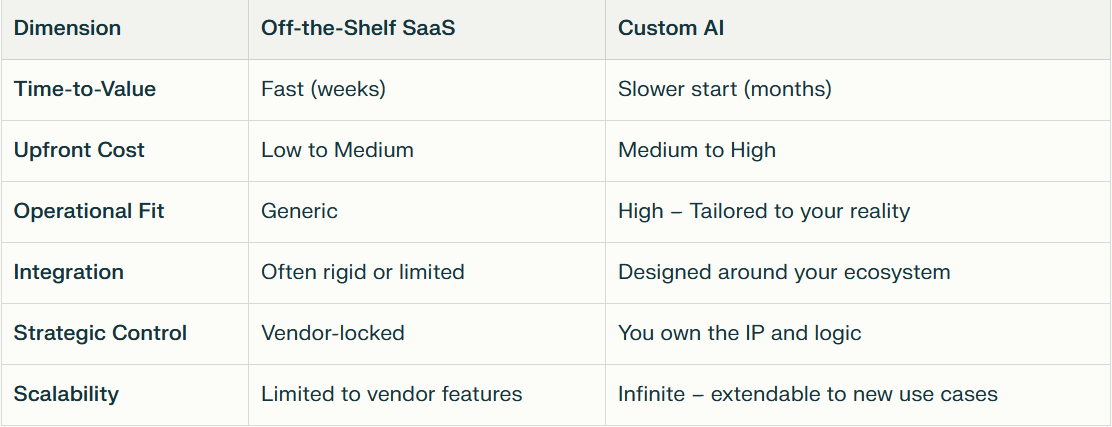
The key takeaway: SaaS wins on speed and simplicity. Custom AI wins on fit and strategic control.
The three real decision drivers: data, processes, scale
Rather than starting from vendor pitches, start from three questions:
1. Data – What data do we really have and how clean is it?
2. Processes – How standardized or unique are our sales and merchandising processes?
3. Scale – At what scale do small percentage gains translate into serious money?
1. Data: Do you have a “single version of truth” for sales and assortment?
For assortment optimization or AI in sales to work, you need at least:
• Reliable transaction data (online + offline)
• Clear product hierarchy and attributes
• Store/channel data (formats, sizes, regions)
• Promotion history
• Inventory and supply constraints
If today:
• These live in multiple systems that “almost” talk to each other
• A lot of logic is in people’s heads or spreadsheets
• Reporting takes days because teams need to reconcile sources
…then a custom AI layer built on top of a unified data model will almost always beat adding yet another SaaS tool.
Why? Because the biggest value is not in a fancy algorithm, but in the ability to use your entire data context consistently.
2. Processes: Are you truly different from “average retail”?
If your business is relatively standard:
• Few store formats
• Simple promotion mechanics
• Basic online/offline integration
…then a good SaaS tool can deliver solid value quickly.
But if you have:
• Multiple countries, formats, franchisees
• Complex local assortments
• Strong private label portfolio
• Advanced promotion rules and constraints
…then generic SaaS often forces you to simplify your reality to fit the tool. In the short term it looks cheaper; in the long term you lose margin and agility.
Custom AI lets you encode:
• Your real constraints (e.g. minimal depth per SKU, display rules)
• Your specific KPIs (e.g. contribution margin after logistics)
• Your omnichannel logic (e.g. online only SKUs vs store only)
3. Scale: When do 1–2% really matter?
For a small retailer, a 1–2% gain in margin or stock turn may not justify a custom AI project.
For a mid size or large omnichannel player:
• 1% improvement in margin
• 2–3% reduction in markdowns
• 3–5 days reduction in stock holding
…can translate into millions in additional profit or released cash every year.
At this scale, it’s worth investing in a solution that is built around your data and processes – not the other way around.
How to think about ROI of AI (without the buzzwords)
Many boards are stuck at: “We don’t see clear ROI from AI.”
A simple framework:
1. Start from a concrete level
- Example: assortment optimization in key categories, or AI supported sales decisions in specific channels.
2. Define baseline and target
- Baseline: current sell through, margin, stock days, number of out of stocks, etc.
- Target: realistic uplift (e.g. +1.5% margin, −10% markdowns) based on pilots or benchmarks.
3. Link AI decisions to P&L
- Show how better assortment or better sales decisions change revenue, margin, and working capital.
4 Include integration and change management
- A “perfect model” is useless if it’s not embedded in existing tools and workflows (ERP, POS, WMS, e commerce, BI dashboards).
This is exactly where a custom decision layer (often built on top of existing tools) can make the difference. It connects AI outputs to the systems and people who make daily decisions.
Checklist: When to choose Off the Shelf SaaS vs Custom AI
Use this as a quick sanity check in your leadership team.
Choose Off the Shelf SaaS if:
• You need fast wins to test AI in a low risk way
• Your processes are relatively standard
• You have limited internal data/IT resources for now
• Integration is “nice to have”, but not mission critical
• You are below the scale where every 1% margin improvement makes a major impact
Choose (or move towards) Custom AI if:
• You operate an omnichannel model with significant scale
• Your assortment and promotion logic are more complex than what standard tools support
• You already suffer from tool chaos and data silos
• Integration with ERP/POS/WMS/e commerce is key to adoption
• You want full control over data, security and AI logic
• You see clear potential to improve margin, sell through or stock by a few percent – and that translates into serious money
Consider a hybrid path:
In practice, many retailers:
• Start with one or two focused SaaS tools
• Consolidate and clean data
• Then build a custom decision layer on top (e.g. for assortment optimization and sales AI), orchestrating both internal systems and external tools
This path balances speed now with strategic control later.
FAQ for C level decision makers
Q: Do we need a full data science team to benefit from custom AI?
A: Not necessarily. Many organizations work with specialized partners who bring AI expertise, while your team provides business context and access to data. The key is to ensure that knowledge does not stay as a “black box” with the vendor – you should own the logic and data.
Q: Is custom AI always more expensive than SaaS?
A: Upfront – usually yes. Over a 3–5 year horizon, especially at scale, custom AI can be more cost effective because it drives higher impact and reduces dependency on multiple overlapping tools.
Q: How do we reduce the risk of a custom AI project?
A: Start with a narrow use case (e.g. one category, one region, one channel), define clear KPIs, integrate with existing systems from day one, and run an A/B test against current practice or a SaaS benchmark.
Q: What about data security and privacy?
A: With custom AI deployed in environments you control (cloud or on prem), you define how and where data is stored, who has access, and how models are audited. This is often a strong argument for custom solutions, especially when working with sensitive transactions and customer data.
Q: Is it realistic to integrate AI into all our systems (ERP, POS, WMS, e commerce)?
A: It’s not about integrating “everything at once”. The right approach is to identify where AI decisions must appear (e.g. in the tool used by category managers or sales managers) and integrate there first. A well designed custom layer can later connect to additional systems step by step.

