
Introduction: India Is Leading in AI Adoption, but Adoption Alone Is Not Enough
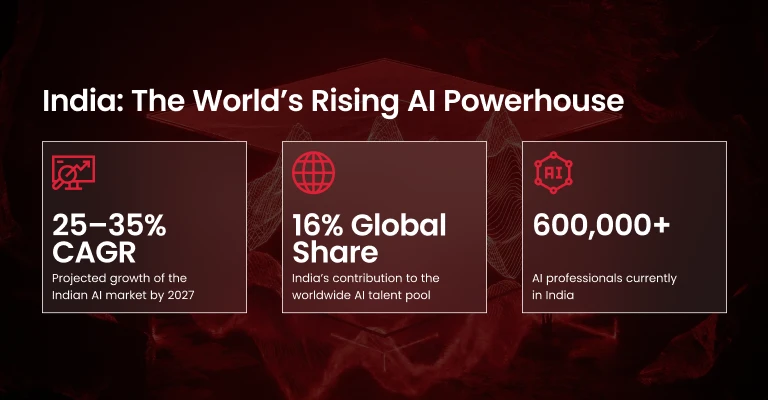
India is no longer an emerging AI market. It is already one of the most dynamic AI economies in the world. According to NASSCOM's AI Adoption Index 2.0 (2024), India's AI market is expected to grow at a 25-35% CAGR by 2027, with 70% of enterprises now spending over 20% of their IT budgets on digital initiatives [1]. From widespread use of generative AI tools to rapid enterprise experimentation, Indian organizations are moving faster than many global peers.
But there is a difference between AI adoption and AI transformation. Using AI tools occasionally is not the same as embedding AI into day-to-day business operations, decision-making, and team capabilities. That gap is where many companies now find themselves.
According to NASSCOM's State of Responsible AI in India 2025 survey of over 500 enterprises, while 60% of businesses report having matured RAI practices or initiating formal steps toward adoption, only 30% have successfully embedded AI strategy with broader corporate strategy[2]. They are excited about AI, they see the headlines, and they have early pilots in motion. Yet real enterprise value still feels uneven.
For business leaders in India, the challenge is no longer whether AI matters. The challenge is how to turn high AI adoption into measurable business impact.
Why AI Transformation in India Matters Right Now
Several trends are converging at the same time. India has a large digital-first workforce, a growing pool of AI talent (representing 16% of the global AI talent base with 600,000+ professionals), strong momentum in Global Capability Centers, and rising pressure to compete through speed, efficiency, and innovation. That makes this a defining moment for AI transformation in India [1].
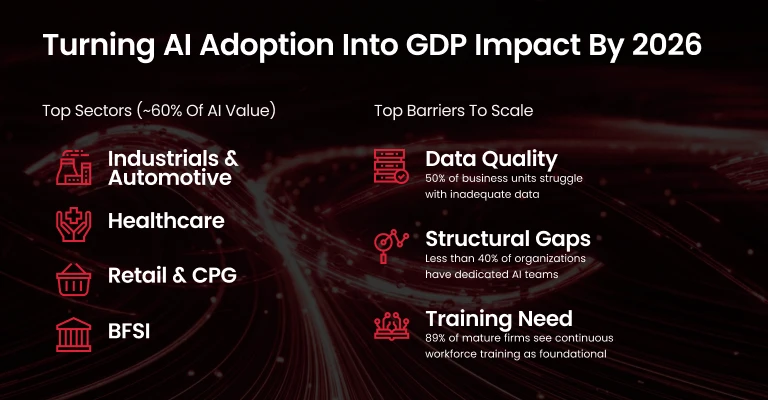
NASSCOM's research shows that four key sectors: Industrials & Automotive, Healthcare, Retail & CPG, and BFSI, are expected to contribute ~60% of the potential AI-driven value to India's GDP by FY 2026[^3]. That makes this a defining moment for AI transformation in India [3].
Companies that move from fragmented experimentation to structured adoption can improve productivity, strengthen decision-making, and build long-term competitive advantage. Companies that stay in pilot mode may continue investing without seeing enterprise-scale returns.
This is especially important in sectors such as Retail, CPG, Financial Services, Manufacturing, Healthcare, and Technology, where AI can reshape workflows across Sales, Operations, Finance, Customer Service, and Supply Chain Management.
The AI Adoption Paradox in Indian Enterprises
One of the most interesting features of the Indian market is the contrast between strong enthusiasm and inconsistent organizational readiness. The NASSCOM data reveals this paradox clearly:
The Promise:
- 60% of businesses have either matured RAI practices or have initiated formal steps toward adoption[2]
- 70% spend over 20% of IT budgets on digital transformation[1]
- Four key sectors poised to contribute ~60% of AI-driven GDP value by FY 2026[3]
The Challenge:
- Less than 15% have aligned AI strategy with broader corporate strategy[3]
- 67% allocate less than 10% of their IT budget specifically to AI[3]
- Lack of high-quality data and shortage of skilled personnel remain the biggest barriers to implementation[2]
- 50% need adequate data at the business unit level to develop standards[3]

Teams often experiment with ChatGPT, copilots, analytics assistants, and automation tools on their own. In many cases, that creates momentum. But it can also create silos. One department may move ahead quickly, while another is still unsure how to use AI responsibly. Some employees become power users, while others receive only basic awareness sessions.
eaders may support AI strategically, but governance, data readiness, and workflow redesign remain underdeveloped. This is the AI adoption paradox: India is moving quickly, but many organizations still need a more systematic path from individual experimentation to enterprise transformation.
What Prevents AI from Scaling Across the Organization
The barriers are usually not mysterious. According to NASSCOM's comprehensive research, several patterns emerge:
First, AI initiatives are often fragmented across business units, which makes it hard to create shared standards and reusable knowledge. Building dedicated teams for AI is limited to less than 40% of organizations[3].
Second, many organizations still treat AI training as a one-off activity instead of an ongoing capability-building process. The survey reveals that 89% of businesses with matured RAI practices committed to continuing investments in workforce sensitization and training, while over 60% of those with lower maturity levels also recognized this need [2]
Third, companies worry about risks such as data leakage, shadow AI, and governance gaps, so they either over-control experimentation or allow it to grow without structure.
Fourth, the data foundation is not always ready. NASSCOM found that end-users see value in moving ahead on the AI adoption curve but are hamstrung by legacy systems and siloed data [3] Even the best AI strategy struggles when data is inconsistent, inaccessible, or disconnected from real workflows.
When these issues appear together, AI remains interesting but does not become operational.
How DS STREAM Helps Solve These Specific Challenges
This is where DS STREAM becomes especially relevant. The company helps organizations address the exact challenges that often slow AI transformation in India: fragmented AI adoption, disconnected use cases, incomplete AI training, weak governance, and limited data readiness. Rather than treating AI as a standalone technology project, DS STREAM focuses on building practical, scalable capability inside the organization. That includes role-based AI enablement, structured adoption programs, support for moving from experimentation to production, and a clear approach to governance and expansion. For enterprises and GCCs that want to avoid scattered pilots and create real operational value, this kind of support is often what makes the difference between early enthusiasm and long-term success.
Why Global Experience Can Accelerate AI Transformation in India
The good news is that these are not uniquely Indian problems. They have already appeared in other markets, industries, and transformation programs. Organizations across North America and Europe have faced the same reality: plenty of interest, scattered use cases, weak coordination, and slow movement from pilot to production. That is why proven AI transformation methods matter. Global experience helps companies avoid repeating the same mistakes. It also brings perspective on what actually drives adoption: role-specific learning, practical use cases, strong governance, and a clear process for scaling what works. For Indian enterprises and GCCs, this combination of global experience and local execution can significantly reduce the cost of trial and error. As NASSCOM data shows, large enterprises (annual revenue > Rs 250 crore) are 2.3 times more likely than startups and 1.5 times more likely than SMEs to report matured RAI practices[^2]—suggesting that structured approaches yield better results [2]
Why GCCs in India Are Central to the Next Phase of AI Growth
India’s Global Capability Centers are becoming one of the most important engines of enterprise AI transformation. They are no longer just back-office or cost-efficiency hubs. Many GCCs now own end-to-end processes, digital platforms, advanced analytics, and innovation programs for global organizations. That gives them a unique role in AI adoption. They need to move quickly, prove ROI, support reskilling, and align with global governance standards at the same time. In practice, that means GCCs are under pressure to do more than run pilots. They need to build AI capabilities that are scalable, secure, and tied to business outcomes. This is exactly why structured AI transformation programs are becoming so relevant for the GCC model in India.
A More Practical Approach to Enterprise AI Adoption
The most effective AI transformation strategies do not start with technology alone. They start with context. Teams need to understand where AI can genuinely improve work, which use cases matter most, and what skills are required at each level of the organization. A practical approach usually includes four stages: awareness, learning, usage, and expansion. Awareness helps leaders and employees understand what AI can and cannot do. Learning builds real skills in the context of actual business roles. Usage focuses on guided application so that AI becomes part of everyday work rather than a side experiment. Expansion identifies what has created value and scales it more broadly. This type of structure helps organizations move from excitement to consistency.
This type of structure helps organizations move from excitement to consistency. Research from NASSCOM supports this: organizations with higher AI maturity demonstrate higher RAI maturity, with more than 60% of respondents with high AI maturity reporting matured RAI practices [2]
Why Human-Centered AI Training Works Better
One of the biggest lessons from AI transformation work globally is that people adopt AI faster when training feels relevant. Generic sessions on prompting or AI trends can create initial interest, but they do not automatically change behavior. A finance team needs to see how AI improves reporting, forecasting, or compliance tasks. An operations team needs use cases linked to planning, process visibility, or execution. Sales teams respond better when AI supports pipeline management, customer insight, or territory planning. Human-centered AI training is more effective because it speaks the language of the role. It also reduces resistance, since employees can quickly see that AI is helping them work better rather than replacing them. This approach aligns with NASSCOM's finding that 89% of businesses with matured practices committed to workforce training, recognizing it as fundamental to sustainable adoption [2].
From DIY AI to Scaled Enterprise Solutions
Another strong model for AI adoption in India is the move from employee-led experimentation to professional scaling. In many organizations, employees can create simple automations or lightweight AI agents using no-code and low-code tools. This is valuable because it encourages learning by doing and helps uncover practical, high-value use cases. But once a solution starts proving business value, it usually needs stronger architecture, security, governance, and integration. That is when expert support becomes essential. The most successful organizations do not choose between democratization and control. They combine both. They let teams explore, then scale the best ideas properly.
Conclusion: India Can Lead Not Only in AI Adoption, but in AI Impact
India already has the momentum, talent, and market urgency to become a global leader in enterprise AI. The next step is to convert that momentum into structured, scalable business value. That means building AI literacy across the workforce, designing role-based learning paths, strengthening governance, improving data readiness, and creating a clear path from experimentation to enterprise deployment.
As NASSCOM research shows, sectors facing higher disruption have embraced AI more holistically, and strong national support pillars have emerged—including the IndiaAI Mission, supportive policy frameworks, and AI-ready tech services [1]
For Indian enterprises and GCCs alike, the winners in the next phase of AI transformation will not simply be the ones using the most tools. They will be the ones that embed AI into the way work gets done and make that change stick. That is how AI adoption turns into AI impact.
References
[1]: NASSCOM (2024). "AI Adoption Index 2.0: Tracking India's Sectoral Progress in AI Adoption." Retrieved from https://nasscom.in/knowledge-center/publications/ai-adoption-index-20-tracking-indias-sectoral-progress-ai-adoption
[2]: NASSCOM (2026). "The State of Responsible AI in India 2025 Survey Report." Retrieved from https://www.nasscom.in/ai/pdf/rai_survey_report_2026_compressed.pdf
[3]: NASSCOM. "The NASSCOM AI Adoption Index." Retrieved from https://www.nasscom.in/knowledge-center/publications/nasscom-ai-adoption-index

