Introduction: Why Assortment Decisions Matter More Than Ever
Retail and FMCG companies in India are operating in a much more complex environment than they were just a few years ago. By early 2026, India’s FMCG market has scaled to ₹8.5–9 trillion, with growth increasingly fragmented across general trade, modern trade, e‑commerce, quick commerce, and D2C brands, all competing for the same consumer wallet. At the same time, shoppers are more promotion-sensitive, less predictable, and less loyal to traditional purchase patterns. In this kind of market, assortment and category management directly shape sales, margin, and shelf productivity. Yet in many organizations, key assortment decisions are still made through disconnected spreadsheets, static reports, and intuition. That is where assortment chaos begins.
What Assortment Chaos Looks Like in Practice

Most retail and FMCG leaders recognize the symptoms immediately. Too many low-performing SKUs remain in the range because there is no shared, data‑backed mechanism to remove them. Industry analyses in early 2026 show that in large Indian retail and FMCG portfolios, 20–30% of SKUs contribute negligible or negative profit while still consuming up to 40% of shelf space, working capital, and planning effort, making SKU sprawl a structural profitability drag. no one wants to remove them. High-margin or fast-moving products do not get the shelf space they deserve. Promotions are repeated out of habit rather than evaluated for real return. Stores experience stockouts on winning products while slow movers continue tying up capital in the background. These problems are not just operational annoyances. They have a direct impact on profitability, customer satisfaction, and internal alignment between category, sales, and trade teams.
Why AI-Driven Category Management Changes the Game
AI-driven category management does not remove human judgment. It improves it. Instead of relying on gut feel, category managers can use structured analytics to understand which SKUs really drive volume, which products contribute to margin, how promotions perform across regions, and where space allocation is hurting performance. This is especially valuable in India, where shopper behavior differs significantly by region, channel, and store format. NielsenIQ’s 2026 India FMCG snapshots show that modern trade and e‑commerce respond three times faster than traditional trade to pricing, promotion, and assortment changes, creating uneven performance when a single national assortment logic is applied uniformlyA single national assortment logic is becoming less effective. AI makes it possible to move toward more localized, responsive, and commercially sound decisions at scale.
The Four Building Blocks of Better Assortment Decisions
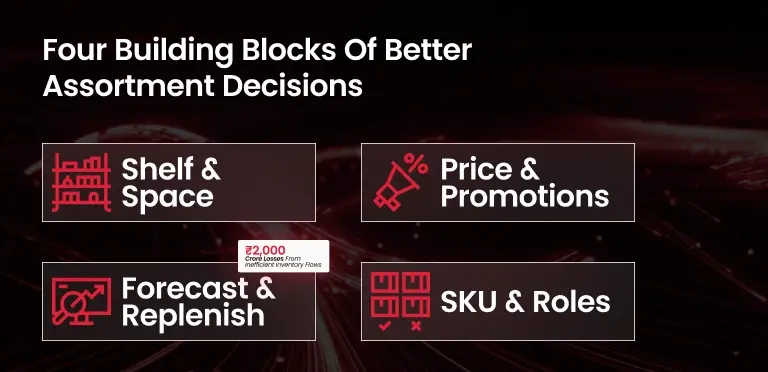
A practical approach to category transformation usually rests on four connected areas. The first is shelf and space optimization, which helps determine how much room each product should actually receive. A Retailers Association of India (RAI) report published in February 2026 highlights that many organized retailers still carry excess SKUs despite shrinking effective shelf space, directly depressing sales density and full‑price sell‑through. The second is price and promotion analytics, which shows where discounts create true incremental value and where they simply erode margin. The third is demand forecasting and replenishment planning, which improves product availability while reducing unnecessary inventory. A 2026 analysis tracking over 15,000 Indian stores found that inefficient internal inventory flows alone create over ₹2,000 crore in annual losses, underscoring the need for predictive, system‑driven forecasting and replenishment. The fourth is SKU rationalization and category role definition, which helps companies decide what to keep, grow, fix, or remove from the range.
What Good Category Management Looks Like
When these capabilities come together, category management becomes more focused and more consistent. Instead of managing thousands of SKUs with the same level of attention, teams can identify core products, strategic items, innovation plays, and low-value overlap. Shelf decisions become tied to actual productivity. Promotion plans become more targeted. Demand planning improves because forecasting is done at the right level of granularity. Most importantly, category teams gain a clearer view of what is driving business value instead of reacting to isolated data points or internal pressure.
A Practical Transformation Path
The journey usually starts with diagnosis rather than technology. Companies need to map how assortment decisions are made today, where the biggest leaks in value are, and which business questions matter most. From there, they need to strengthen the data foundation by bringing together sell-out data, shipments, promotions, planograms, and product hierarchies into one analytical environment. Only then does it make sense to build the decision engine: models and analytics for SKU rationalization, shelf optimization, pricing, promotions, and replenishment. This sequence matters because advanced tools rarely succeed on top of weak data and unclear business priorities.
How Generative AI Makes Analytics Easier to Use
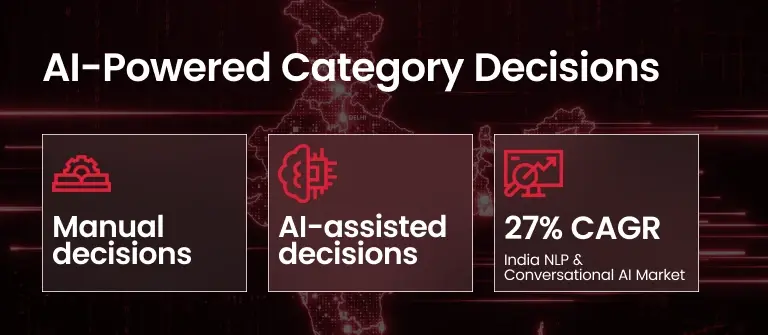
Generative AI adds an important new layer to category management because it makes insights more accessible. Instead of waiting for a specialist analyst, category managers can use natural-language assistants to ask practical questions such as which SKUs are under-spaced, which promotions are underperforming, or what the likely effect of delisting a product would be in a specific cluster. Research released in 2026 shows that India’s natural‑language‑processing and conversational AI market is growing at over 27% CAGR, driven by enterprise demand for self‑service insight and decision support across functions such as retail, supply chain, and analytics. This kind of AI support reduces friction between data and decision-making. It also allows teams to work faster without sacrificing analytical quality.
Why This Matters in the Indian Market
India’s retail and FMCG landscape is especially well suited to AI-driven category management because complexity is built into the market. Consumer demand varies sharply not just by state or city tier, but often by PIN code and catchment. Even neighboring urban catchments can exhibit materially different demand profiles, price sensitivity, and format economics. Regional preferences vary sharply. Channels are evolving quickly. Quick commerce and omnichannel retail are changing demand patterns. In this environment, companies cannot afford to make assortment choices using slow, manual methods alone. Those that combine local market insight with strong analytics will be better positioned to improve margin, reduce waste, and react faster to market shifts.
What Leaders Should Do First
For many organizations, the smartest first step is not a full transformation program but a focused pilot. Choose one category, one or two channels, and a small set of measurable KPIs such as margin improvement, on-shelf availability, or promotion ROI. Use that pilot to prove the value of stronger data, better analytics, and AI-assisted decision-making. Once the commercial benefit is visible, it becomes much easier to scale the model across more categories and markets.
Conclusion: From Complexity to Control
Assortment chaos is not inevitable. It is usually the result of outdated processes struggling to keep up with a more demanding market. AI-driven category management offers a more disciplined, scalable, and commercially intelligent alternative. For Indian retail and FMCG companies, the real opportunity is not just better reporting. It is better judgment at scale. And in a market where range decisions influence both growth and profitability, that can become a serious competitive advantage.
References
[1]: EY (2025). "India’s GCCs are leading the shift to Intelligent, AI-native enterprises" Retrieved from https://www.ey.com/en_in/insights/consulting/global-capability-centers/india-s-gccs-are-leading-the-shift-to-intelligent-ai-native-enterprises
[2]: EY (2026). "How India GCCs are powering core industry processes in Retail and CPG sector" Retrieved from https://www.ey.com/en_in/insights/consulting/global-capability-centers/how-india-gcc-s-are-powering-core-industry-processes-in-retail-and-cpg-sector
[3]: NVIDIA (2026). "State of AI in Retail and CPG" Retrieved from https://resources.nvidia.com/en-us-nvidia-retail/state-of-ai-in-retail-and-cpg[1]: Business Base (2026). "FMCG Industry in India 2026: Size, Growth, Challenges, and Forecast" Retrieved from https://www.ey.com/en_in/insights/consulting/global-capability-centers/india-s-gccs-are-leading-the-shift-to-intelligent-ai-native-enterprises
[2]: Datawiz.io (2026). “What’s the Best Way to Perform SKU Rationalization in a Retail Chain?” Retrieved from https://datawiz.io/en/blog/whats-the-best-way-to-perform-sku-rationalization-in-a-retail-chain
[3]: Market Research Future (2026). "India Natural Language Processing Market" Retrieved from https://resources.nvidia.com/en-us-nvidia-retail/state-of-ai-in-retail-and-cpg
[4]: Kearney (2026). “India Retail Index 2026: From Cities to Hyperlocal”. Retrieved from https://www.kearney.com/industry/consumer-retail/article/kearney-india-retail-index-2026

