
Retail in 2026 is harder because the scale and complexity of the business have exploded. Teams now manage more SKUs, more stores, more promotions, more volatile demand, and tighter margins than ever before. No human team can handle all of this manually every day without leaving value on the table.
Retail teams need tools that help them protect margins, reduce waste, and make faster decisions in a market that changes daily. The pressure is real: more SKUs, more stores, more promotions, and more customer volatility than most organizations can handle with manual processes alone. What is needed is not more promises about AI, but practical, hands-on tools.
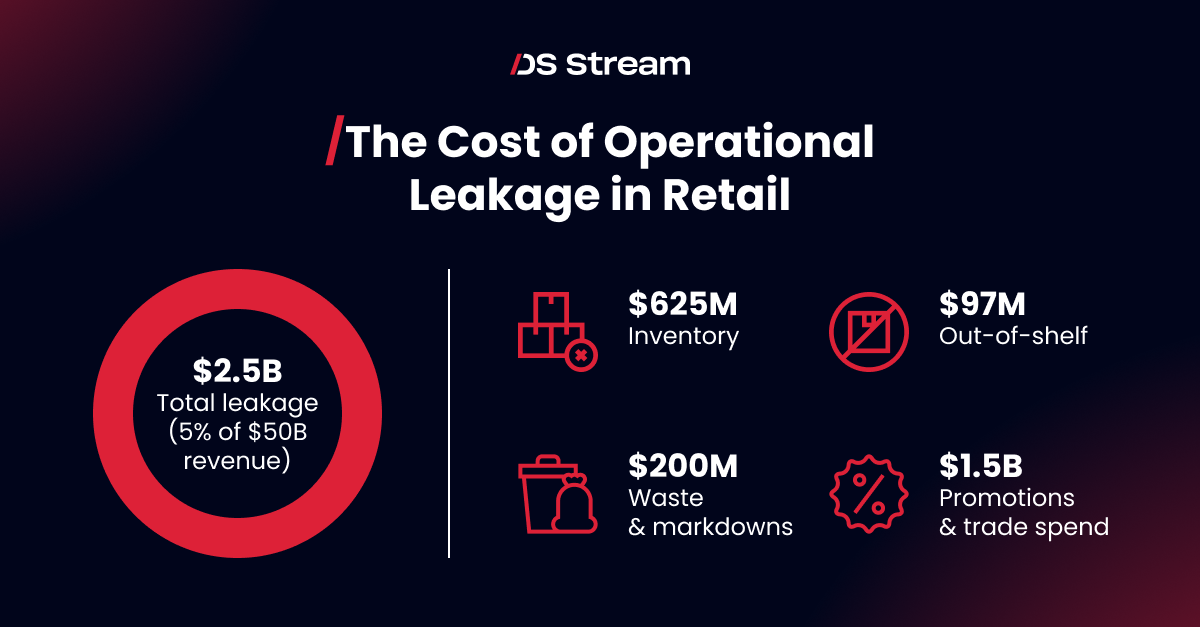
A useful way to understand the problem is through scale. Imagine a retailer with 50 billion dollars in annual revenue. If even 5 percent of that value leaks due to operational inefficiencies, the annual loss reaches 2.5 billion dollars. That is not just a theoretical figure, it is the kind of number that changes how leaders think about inventory, promotions, and replenishment.
Inventory accuracy is one of the biggest sources of waste. Losses tied to inventory inaccuracy and stock imbalance can reach around 625 million dollars per year. Phantom stock, incorrect system data, and weak replenishment signals can make a store look healthy on paper while shelves tell a different story. Once that happens, every downstream decision becomes less reliable.
Out-of-shelf situations add another layer of leakage. They are often treated as isolated store issues, but the numbers suggest something larger. Out-of-shelf problems can represent about 97 million dollars in lost sales. That is revenue customers were ready to spend, but the product was simply not available at the right place and time.
Fresh categories are even less forgiving. Timing matters, demand shifts quickly, and waste is costly. Waste and markdowns can account for roughly 200 million dollars in losses, or about 1.6 percent of revenue. The issue is more than just excess stock, it is delayed reaction. By the time teams see the problem in reports, much of the product has already lost value.
Promotions create another blind spot. Retailers often invest heavily in trade spend, but not every promotion generates incremental value. Ineffective promotions and trade spend can form the largest leakage bucket, worth around 1.5 billion dollars in a large retail organization. The key question is not whether a promotion drove sales, but whether it improved profit after accounting for cannibalization, discounting, and trade costs.
At this point, AI stops being decorative and becomes operational. A strong model can combine sales, stock, delivery, and store-level signals into a single operational view. It can identify patterns earlier than weekly reports and help teams understand which locations need attention, which products are at risk, and where the financial upside is greatest.
The goal is to operation teams a better operating system. Instead of navigation disconnected dashboards, they receive recommendations tied directly to business impact. A merchandiser can focus on decisions rather than stitching together data from multiple systems.
One of the most important takeaways is that even small percentage improvements can deliver significant outcomes at retail scale. Recovering just 9 percent of a 2.5 billion dollar inefficiency pool would generate around 225 million dollars in annual value. Within that, inventory and out-of-shelf improvements could recover roughly 155 million, waste reduction about 30 million, promotion efficiency around 22 million, and productivity gains approximately 3 million.

Implementation matters as much as the model itself. AI only works when data is reasonably clean, business rules are clearly defined, and teams trust the output enough to act on it. If inputs are messy, the system simply automates confusion. If KPIs are unclear, the model optimizes the wrong outcomes. And if the organization does not take ownership, the solution will never move beyond the pilot stage.
Change management is equally important. People often resist AI when it feels like surveillance or threatens their expertise. The better positioning is simple: AI supports judgment, it does not replace it. It saves time, reduces guesswork, and allows teams to spend less effort searching for answers and more time acting on them.
What does retail need today? Better decisions, faster feedback loops, and systems that can handle complexity without forcing people to operate in the dark. This is where AI delivers the most value - in everyday operational decisions, not just in strategy presentations. The retailers that succeed will be those that use AI to reduce losses, improve availability, and make their teams more effective every day. In a business where small percentage gains translate into tens or hundreds of millions, this is not just a technical upgrade, it is a competitive advantage.

