
Data engineering consulting services give companies external specialists who design, build, and run the data infrastructure that analytics and AI depend on. A consulting partner handles pipelines, warehouses, and platform architecture, either filling a skills gap or delivering a defined project faster than an in-house team could manage alone.
Most enterprise data problems are not caused by a shortage of tools. They come from infrastructure built for last year's requirements and never re-architected. Reports break when a source schema changes. Machine learning projects stall because the training data arrives late or dirty. This article covers what a data engineering consulting partner actually does, when hiring one beats building in-house, and the questions that separate a capable data engineering consulting company from an expensive staffing agency.
What do data engineering consulting services include?
A data engineering consulting engagement usually covers the full path data takes from source systems to the point where it becomes useful: ingestion, transformation, storage, orchestration, and the governance layer that keeps everything trustworthy. Some partners specialize in one cloud platform, others stay vendor-neutral and recommend the stack that fits your constraints. The common thread is ownership of the plumbing, so your analysts and data scientists work on outcomes instead of firefighting broken jobs.
- Pipeline development for batch and streaming data, including ETL process optimization on jobs that have grown slow or costly.
- Warehouse and lakehouse design on Snowflake, Databricks, BigQuery, or Redshift.
- Cloud migration from on-premise systems or between cloud providers.
- Orchestration and monitoring so failures surface before a business user notices.
- Data quality, lineage, and governance controls for audit and compliance.
- MLOps foundations that let models ship and retrain on a schedule.
Good partners also document what they build and hand it over. If the work only functions while the consultants are in the room, you have bought dependency, not capability. Ask early how knowledge transfer happens and what the exit state looks like once the engagement ends.
In-house vs consulting: when does each make sense?
Building an in-house data engineering team makes sense when data work is continuous, central to the product, and predictable enough to justify permanent headcount. A payments company or a marketplace needs engineers who live inside the domain every day. The trade-off is time. Hiring senior data engineers takes months, and the market stays tight. According to the Databricks State of Data and AI 2026 report, 71% of data teams are building AI-ready infrastructure this year, which means the same scarce specialists are in demand everywhere at once.
Consulting makes sense when the need is a project, a deadline, or a capability you do not yet have. A partner brings engineers who have already built the thing you are attempting, so you skip the learning curve and the hiring cycle. The comparison below shows how the two options tend to differ on the metrics decision-makers care about.
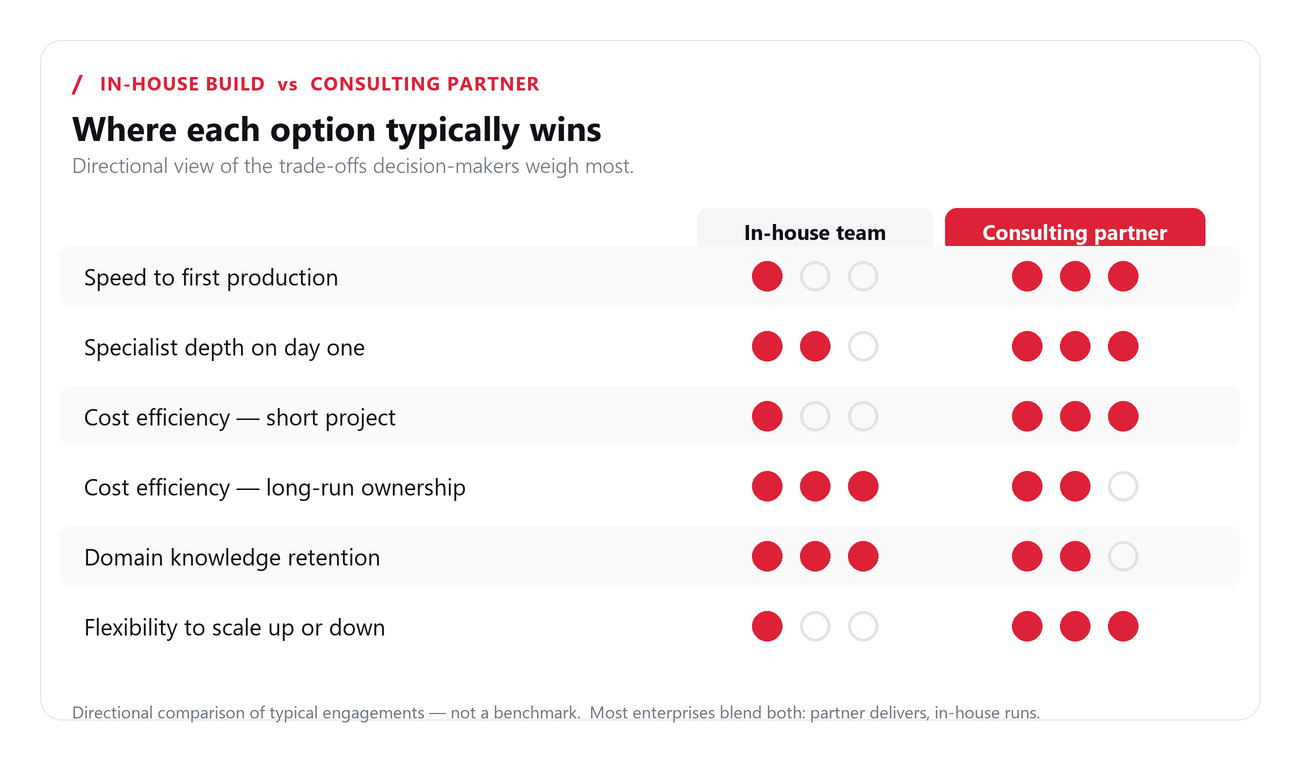
Most enterprises end up with a mix. A partner delivers the initial platform or migration, then a smaller in-house team runs and extends it. That model gives you speed at the start and control afterward, which is usually cheaper than staffing for a peak you only hit once.
When should you outsource data engineering?
Outsource when the cost of waiting is higher than the cost of the engagement. A few signals show up repeatedly. Your data team spends more time maintaining pipelines than delivering new ones. A cloud migration or platform rebuild has sat on the roadmap for a year without moving. An AI initiative has executive backing but no infrastructure to train or serve models. Hiring has stalled and the roadmap keeps slipping because of it.
The decision also depends on how specialized the work is. Migrating to a lakehouse architecture or standing up streaming infrastructure are things a good partner has done dozens of times and your team may attempt once. Paying for that experience often costs less than paying your own engineers to learn it live on a production system. For a broader view of where outside data specialists add value, see our take on what a data consultancy actually delivers.
How to choose a data engineering consulting partner
Choosing a data engineering partner comes down to evidence, not pitch quality. Any firm can describe a modern data stack. Fewer can show production systems they built that still run without them. Ask for references you can actually call, and ask those references what broke and how the partner responded. That answer tells you more than any case study slide.
Look at how the firm staffs engagements. Some sell you a senior architect in the sales meeting, then deliver with junior engineers you never met. Confirm who will do the work and how much of their time you get. Check whether they are tied to one vendor, because a partner that only ever recommends the platform they resell may not be recommending the platform you need. Technical depth matters, and so does the willingness to say no to work that will not help you.
What does a consulting engagement look like?
A well-run engagement starts with discovery rather than code. The partner audits your current systems, data sources, and pain points, then proposes an architecture and a delivery plan with clear milestones. This phase should produce a document you understand, not a wall of jargon. If you cannot explain the plan to your own stakeholders after reading it, that is a warning sign about how the rest will go.
Delivery then happens in increments. You should see working pipelines and running infrastructure at regular checkpoints, not one large reveal at the end. The stronger partners build systems designed to keep running under real load, which is a different skill from making a demo work once. Our guide on data pipelines that survive production covers what that reliability actually requires. Every engagement should also define how the work is handed over, documented, and supported once the partner steps back.
Red flags and questions to ask
Some warning signs appear before you sign anything. A partner who quotes a fixed price before understanding your data has not understood your data. One who promises a full platform in a few weeks is either scoping something trivial or setting up a change-order fight later. Vague answers about who owns the code, the credentials, and the documentation at the end should stop the conversation until they are resolved.
- Who exactly will build this, and can I meet them before we start?
- Show me a production system you built that runs without your involvement.
- How do you handle knowledge transfer and offboarding?
- What happens to cost and timeline when requirements change mid-project?
- Are you tied to any platform vendor, and how does that shape your advice?
The quality of the answers matters more than their content. A strong partner welcomes these questions because the answers are ready. Hesitation or deflection is data.
Pricing and engagement models
Data engineering consulting is priced in a few common ways, and the right one depends on how well-defined your work is. Time-and-materials fits open-ended or evolving scopes where you want flexibility and pay for hours worked. Fixed-price fits tightly scoped projects with clear deliverables, though it rewards careful specification up front. A managed or retainer model fits ongoing operation and support, where the partner runs and improves your platform over time.
Avoid anchoring on day rate alone. A senior engineer at a higher rate who finishes in three weeks costs less than a cheaper team that takes three months and leaves you with fragile systems. Judge the total cost of the outcome, including what you will spend maintaining the result. Where data science and machine learning work each create value also shapes pricing, which we cover in data science vs machine learning.
Working with DS Stream
DS Stream builds and runs data platforms for enterprises that need results faster than hiring allows. If you are weighing whether to build in-house or bring in a partner, or you already know the project and want engineers who have shipped it before, talk to our team. We start with your actual systems and constraints, not a template. Talk to DS Stream to scope your data engineering needs.

