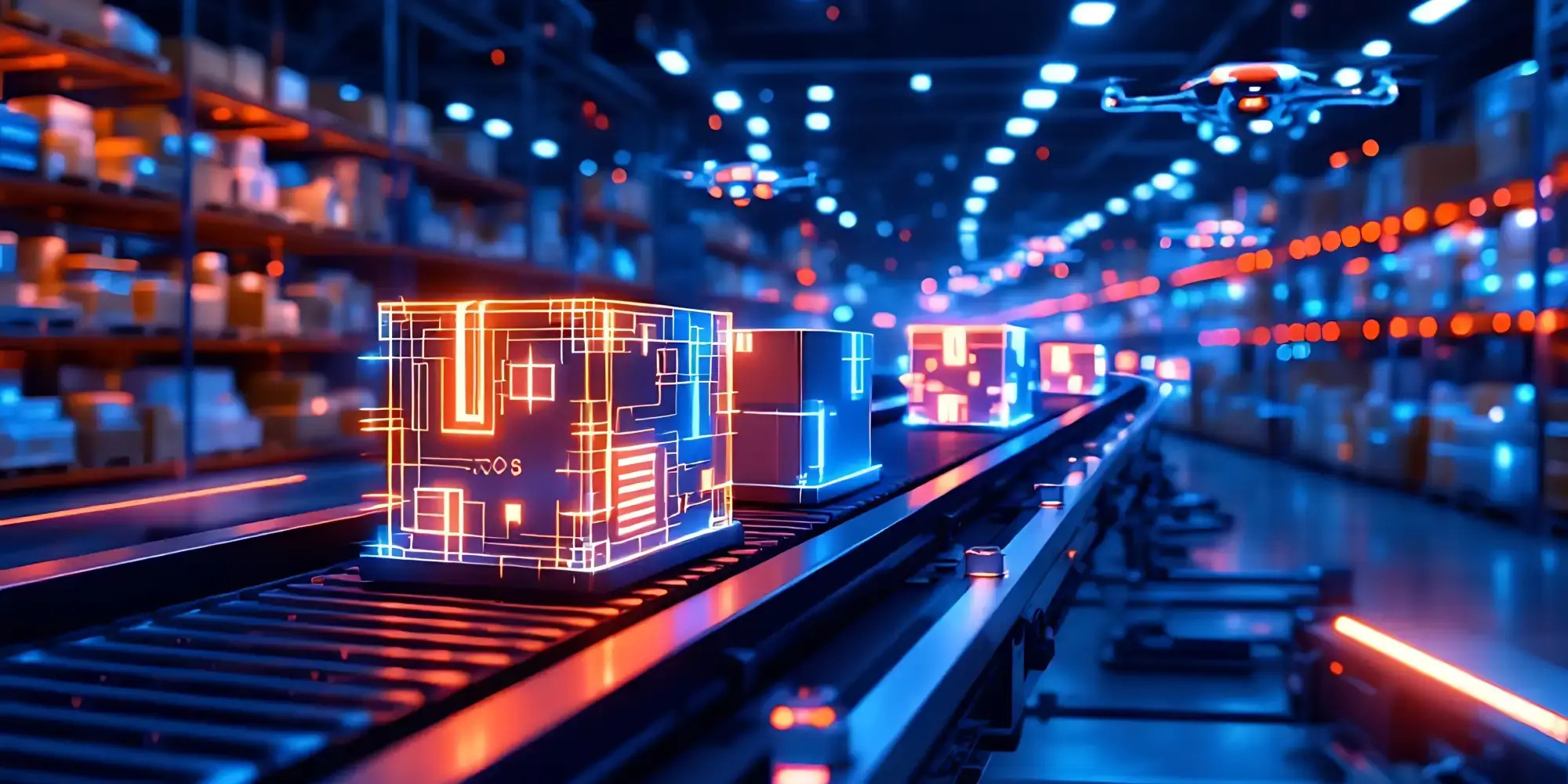
For decades, the standard criticism of Indian logistics single number: logistics costs stuck at double-digit percentages of GDP while developed markets ran near 8%. That number has quietly flipped. India's logistics cost fell to 7.97% of GDP in FY24, below the global benchmark for the first time, on the back of dedicated freight corridors that are now 96.4%operational, a unified data platform (ULIP) that crossed one billion API transactions in March 2025, and 610 million square feet of warehousing stock,more than half of it Grade A.
That is the part of the story infrastructure built. The next part, the one playing out right now across 2,000+ dark stores, robotic fulfillment centers, and two million daily shipments - is being built by AI. In our earlier look at [how India is becoming the AI nerve center for global retail andCPG](https://www.dsstream.com/post/how-india-is-becoming-the-ai-nerve-center-for-global-retail-and-cpg), supply chain appeared as a supporting argument. It deserves the lead role, because India is currently running the world's most demanding supply chain AI experiment - end to end, from the first demand signal to the last hundred meters.
The demand signal: forecasting as a live system
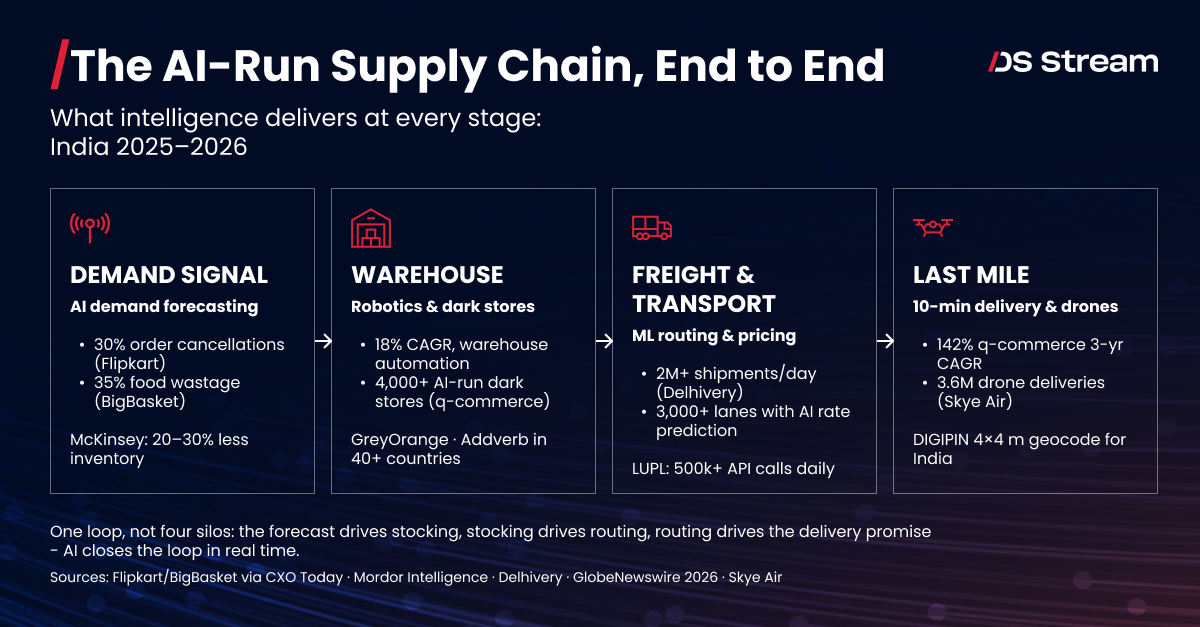
Everything downstream of a bad forecast is expensive: excess inventory, stockouts, markdowns, waste. This is where Indian operators have pushed AI hardest, because the country's demand patterns, festival spikes,regional taste differences, monsoon seasonality, price sensitivity, punish static planning models faster than almost any market on earth.
The results are no longer anecdotal. Flipkart's deep learning models, trained on browsing behavior and purchase histories, cut order cancellations by 30% during peak events like Big Billion Days. BigBasket' regional demand prediction reduced food wastage by roughly 35% - a number that,in perishables, translates directly into margin. These figures align with McKinsey's global benchmarks for AI in distribution: 20–30% inventory reduction and 5–20% logistics cost reduction for mature deployments.
The structural shift behind the numbers matters more than any single stat. Indian FMCG supply chains are moving from periodic planning cycles to what practitioners describe as a live data ecosystem - distributors,warehouses, and retail channels feeding continuous signals back to brands, so the forecast is never a quarterly document but a constantly re-estimated state.It is the same shift we described in [AI-driven category management](https://www.dsstream.com/post/from-assortment-chaos-to-ai-driven-category-management-a-practical-guide-for-retail-and-fmcg):the model stops advising the planner and starts running the loop.
Inside the warehouse: robotics meets the 10-minute clock
India's warehouse automation market is small in absolute terms -around USD 560 million in 2025 - but growing at over 18% annually, and it is producing globally competitive players rather than just importing them. GreyOrange's goods-to-person systems and Noida-based Addverb's autonomous mobile robots now ship to more than 60 countries, while Falcon Autotech's modular retrofit kits are bringing automation to mid-market FMCG and pharma facilities without forcing a greenfield rebuild.
The most extreme laboratory, though, is the dark store.Quick commerce - which we examined in [AI in India's quick commerce and darkstore revolution](https://www.dsstream.com/post/ai-in-indias-quick-commerce-and-dark-store-revolution), compresses the entire warehouse discipline into 2,000–8,000 square feet and a ten-minute service promise. Blink it alone operates roughly 2,100 dark stores;with Zepto and Swiggy Instamart, India runs well over 4,000 of the semicro-fulfillment nodes, each dependent on AI-driven inventory placement,pick-path optimization, and replenishment that anticipates demand at the level of a single neighbourhood. The sector's gross order value doubled to roughly₹64,000 crore (USD 7.6 billion) in FY25, growing at a three-year CAGR of 142%.No human planning process operates at that cadence. The economics enforce the discipline: dark stores break even at 300–400 orders per day, so every percentage point of forecast error or routing inefficiency is visible in the P&L within weeks.
Moving goods: a freight network that finally produces data
AI is only as good as the signals it ingests, and this is where India's decade of digital public infrastructure pays off. ULIP now fields more than 500,000 API calls per day, fusing FASTag tolling data, e-Way Bills, RFID, and vehicle telematics into a single query able layer. Nearly 20,000 container trucks carry AIS-140 telematics feeding dynamic ETA predictions into port systems with 15-minute slot precision. On top of this substrate, Delhi very - handling over two million shipments daily - runs ML-based route optimization and proactive exception alerts, while BlackBuck applies lane-level freight rate prediction across more than 3,000 lanes.
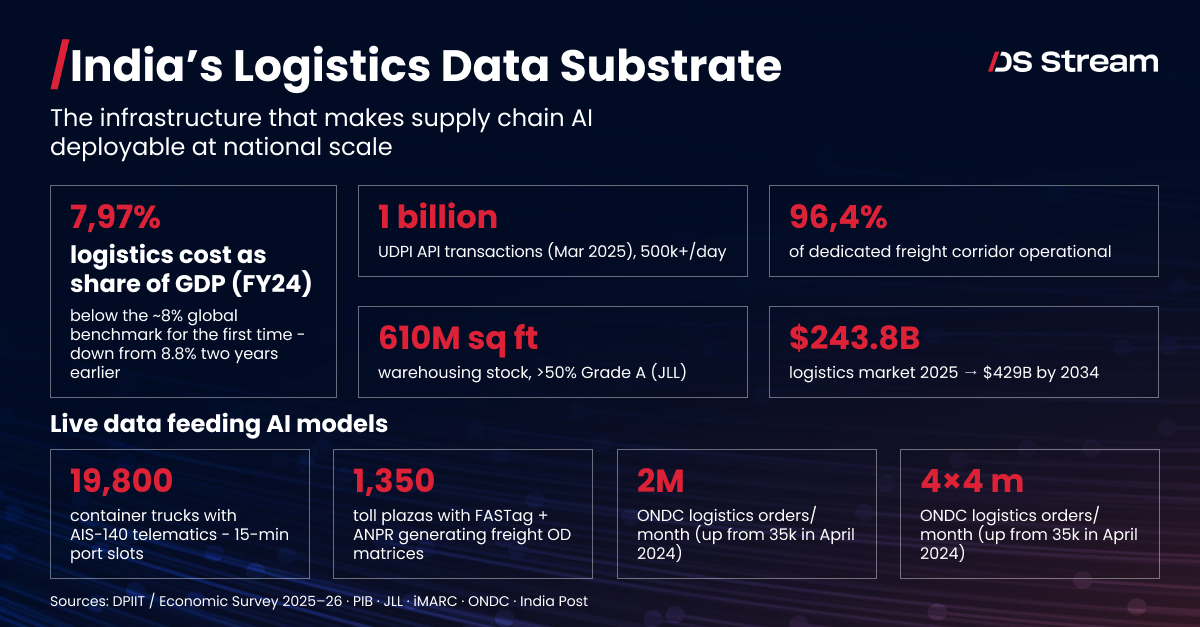
The pattern worth noticing is that the public and private layers compound each other. Dedicated freight corridors shift bulk cargo to rail; ULIP makes movement legible; platforms convert that legibility into optimization. An AI model that predicts truck arrival in Mumbai within minutes is not a software achievement alone - it is the dividend of infrastructure that produces clean data at national scale.
The last mile: India's hardest problem becomes its proving ground
Last-mile delivery consumes an outsized share of logistics cost everywhere, but India adds a uniquely structural obstacle: addresses.Streets with multiple names, houses without numbers, and informal settlements have historically driven failed delivery rates of 5–8%. The fix arrived in May 2025, when India Post - with IIT Hyderabad and ISRO - launched DIGIPIN, a10-character geocode for every four-by-four-meter square in the country. Forrouting models, drone corridors, and delivery clustering algorithms, DIGIPINdoes for location what UPI did for payments: it replaces ambiguity with amachine-readable primitive that every downstream AI system can build on.
The frontier is already visible in Gurugram, where Skye Air has logged some 3.6 million drone deliveries and now operates what it claims isthe world's first fully autonomous delivery chain - AI-dispatched drones to smart mailboxes, with no human touchpoints. Whether drones scale or remain a niche, the underlying capability - AI orchestrating the final hundred meters across riders, robots, and aircraft - is being industrialized in India first,because nowhere else combines this order density with this delivery economics pressure.
The agentic wave - and the honest caveat
The next phase is already priced in. Gartner forecasts that spending on supply chain software with agentic AI will grow from under USD 2 billion in 2025 to USD 53 billion by 2030, with 60% of enterprises using such capabilities by then. ABI Research finds 94% of supply chain leaders planning AI deployment for decision support within two years. India is positioned at the front of this wave: EY reports that 58% of India-based GCCs are already investing in agentic AI, and NASSCOM's adoption index ranks transport and logistics among India's most AI-mature sectors, with 65% of firms pursuing transformation-level strategies rather than scattered pilots.
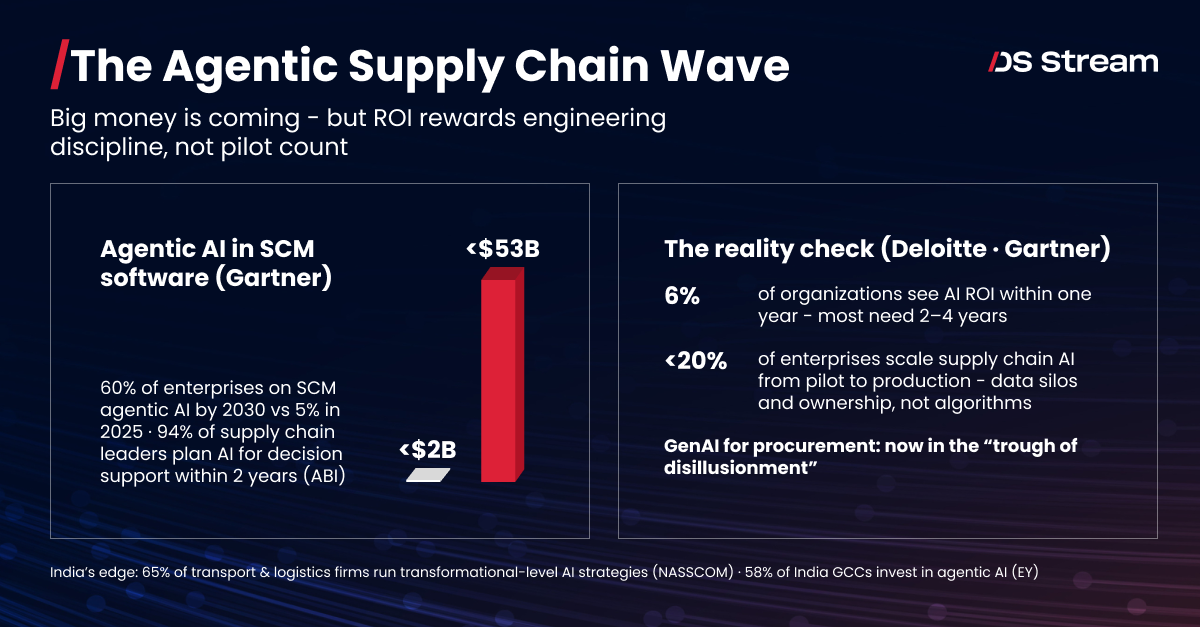
The caveat belongs in the same paragraph as the promise.Deloitte's survey of 1,854 executives found that only 6% of organizations achieve AI ROI within a year; most need two to four. Fewer than 20% of enterprises successfully scale supply chain AI from pilot to production, and the blockers are rarely algorithmic - they are data silos, unclear ownership,and processes that were never redesigned around the model. Gartner has alreadymoved GenAI for procurement into its "trough of disillusionment." The lesson is the one we drew when arguing that [AI in retail has moved from nice-to-have to operational necessity](https://www.dsstream.com/post/why-ai-in-retail-is-moving-from-nice-to-have-to-operational-necessity):the winners are not the companies with the most pilots, but the ones that pick a value chain, instrument it end to end, and engineer the data foundations before scaling the intelligence.
Why this matters beyond India
One more number reframes the whole story: India assembled roughly 55 million iPhones in 2025 - about a quarter of Apple's global output - while PLI-scheme mobile exports have grown eight fold since FY21. As China+1 strategies move global manufacturing into India, the supply chains described here stop being a domestic efficiency story and become part of the world's production backbone. Tariff shocks and Red Sea reroutings have already shown the value of AI-driven risk sensing; firms with supply chain digital twins rerouted 80% of affected shipments proactively during the 2024 crisis.
For enterprise leaders, the conclusion is direct. India's supply chain is no longer a place where AI is being tested - it is a place where AI is being run, under tighter cost, density, and speed constraints than almost anywhere else. The playbooks being written in its dark stores, freight corridors, and forecasting systems will travel. The question is whether your organization will adopt them - or compete against the companies that built them.
---
Sources:
1. [Economic Survey 2025–26: India's logisticscosts fall below 8% of GDP — LogisticsInsider](https://www.logisticsinsider.in/economic-survey-2025-26-indias-logistics-costs-fall-below-8-signalling-infrastructure-payoff/)
2. [DPIIT — Assessment of Logistics Cost in India(2025)](https://master-dpiit.digifootprint.gov.in/static/uploads/2025/09/7d467e0f4aee2362e4bf90b84b7a5332.pdf)
3. [PIB — Logistics: India's Growth Engine (ULIP 1billion API transactions, August2025)](https://www.pib.gov.in/PressNoteDetails.aspx?NoteId=155038&ModuleId=3&lang=2)
4. [IMARC Group — India Logistics Market Report2025](https://www.imarcgroup.com/india-logistics-market)
5. [JLL India — Warehousing Market 2025 (610M sq ftstock)](https://www.jll.com/en-in/insights/indian-warehousing-market)
6. [CBRE via IBEF — Industrial & warehousingleasing up 63% YoY, H12025](https://www.ibef.org/news/industrial-warehousing-spaces-demand-rises-63-to-record-in-h1-2025-cbre)
7. [Mordor Intelligence — India WarehouseAutomation Market2025–2030](https://www.mordorintelligence.com/industry-reports/indian-warehouse-automation-market)
8. [GlobeNewswire — India Quick Commerce Report2026 (market to $12.97B by2029)](https://www.globenewswire.com/news-release/2026/04/20/3277255/28124/en/india-quick-commerce-report-2026-market-to-reach-12-97-billion-by-2029-blinkit-zepto-and-swiggy-instamart-lead-surge-as-jiomart-and-bigbasket-scale-competitive-entry.html)
9. [India Briefing — Quick commerce in India shiftsfocus toprofitability](https://www.india-briefing.com/news/quick-commerce-in-india-shifts-focus-to-profitability-amid-e-retail-boom-38894.html/)
10. [PIB — DIGIPIN launch by India Post, IIT Hyderabad andISRO-NRSC (May2025)](https://www.pib.gov.in/PressReleasePage.aspx?PRID=2131707®=3&lang=2)
11. [Business Standard — DIGIPINexplained](https://www.business-standard.com/india-news/india-post-digipin-pincode-explained-125061000618_1.html)
12. [Sourcing Journal — Arrive AI and Skye Air autonomousdrone deliverypartnership](https://sourcingjournal.com/topics/technology/arrive-ai-skye-air-drone-delivery-india-artificial-intelligence-1234753505/)
13. [Gartner — SCM software with agentic AI to reach $53B by2030 (April2026)](https://www.gartner.com/en/newsroom/press-releases/2026-04-07-gartner-forecasts-supply-chain-management-software-with-agentic-ai-will-grow-to-53-billion-in-spend-by-2030)
14. [Gartner — GenAI for procurement enters the trough ofdisillusionment (July2025)](https://www.gartner.com/en/newsroom/press-releases/2025-07-30-gartner-says-generative-ai-for-procurement-has-entered-the-trough-of-disillusionment)
15. [ABI Research — AI in Supply Chain Survey 2025 (94% planAI/GenAIdeployment)](https://www.abiresearch.com/blog/artificial-intelligence-ai-in-supply-chain-survey-results)
16. [McKinsey — Harnessing the power of AI in distributionoperations](https://www.mckinsey.com/industries/industrials/our-insights/distribution-blog/harnessing-the-power-of-ai-in-distribution-operations)
17. [Deloitte — AI tech investment ROI survey2025](https://www.deloitte.com/us/en/insights/topics/digital-transformation/ai-tech-investment-roi.html)
18. [EY — GCC Pulse Survey 2025 (58% of India GCCs investingin agenticAI)](https://www.ey.com/en_in/newsroom/2025/11/58-percent-gccs-in-india-investing-in-agentic-ai-two-third-creating-dedicated-innovation-teams-to-globalize-ideas-ey-gcc-pulse-survey-2025)
19. [NASSCOM — AI Adoption Index 2.0: tracking India'ssectoralprogress](https://community.nasscom.in/communities/digital-transformation/ai-adoption-index-20-tracking-indias-sectoral-progress-ai)
20. [CXO Today — Can AI predict what India wants to buynext? (Flipkart, BigBasketcases)](https://cxotoday.com/specials/can-ai-predict-what-india-wants-to-buy-next-a-look-at-retail-and-manufacturing-transformation/)
21. [ADA Global — AI-driven demand forecasting in India'sFMCG supplychain](https://www.adaglobal.com/resources/insights/ai-driven-demand-forecasting-in-indias-fmcg-supply-chain)
22. [TechWire Asia — Apple iPhone production: India reaches~25% of global output (March2026)](https://techwireasia.com/2026/03/apple-iphone-production-india-25-percent-global-output/)
23. [PIB — PLI scheme milestones 2025 (mobile exports up ~8xsinceFY21)](https://www.pib.gov.in/PressNoteDetails.aspx?NoteId=155082&ModuleId=3®=3&lang=2)
24. [World Economic Forum — How AI will protect globalsupply chains (digital twins, Red Searerouting)](https://www.weforum.org/stories/2025/01/ai-supply-chains/)

