
India is one of the few large markets where the price on the pack is a legal ceiling, not a suggestion. The Maximum Retail Price, governed by the Legal Metrology Act and the Packaged Commodities Rules, means a retailer cannot charge a rupee above the printed figure, and shoppers know it. That single fact reshapes every conversation about dynamic pricing here. What works in an unregulated Western market, where a price can float up during peak demand, runs straight into consumer law and, more importantly, into consumer memory. Any FMCG or retail leader looking at AI pricing in India has to start from this constraint rather than pretend it away.
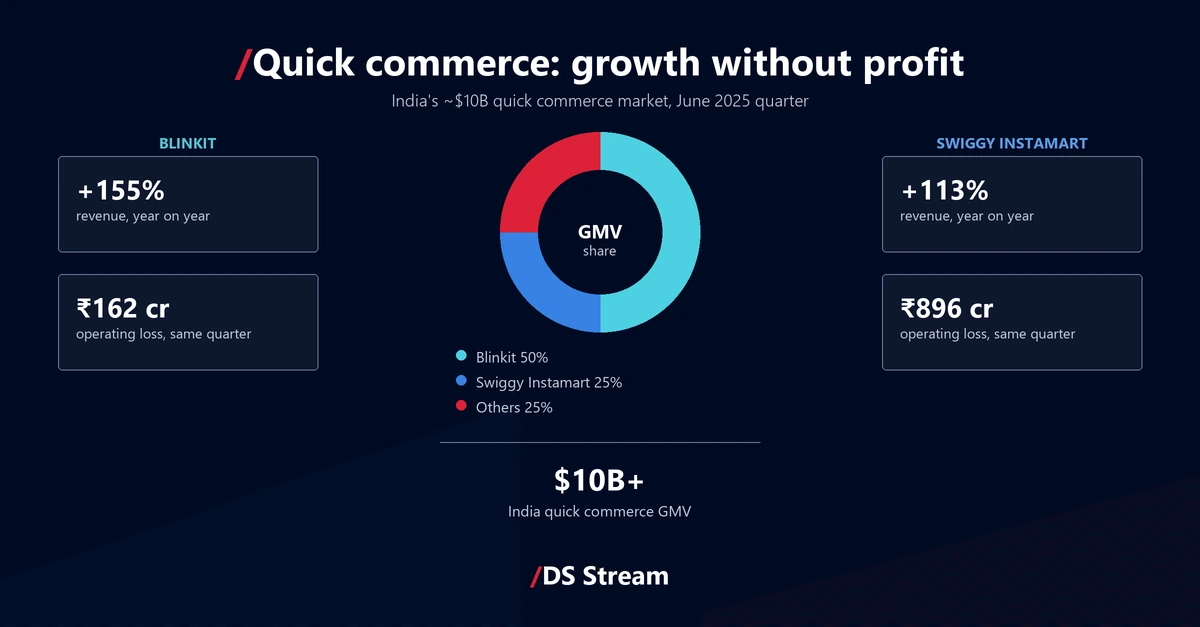
Within that ceiling, though, there is real room to move, and the money at stake is growing fast. India's quick commerce sector has crossed roughly ten billion dollars in gross merchandise value, with Blinkit holding close to half the market and Swiggy Instamart around a quarter. In the June 2025 quarter Blinkit reported revenue of about 2,400 crore rupees, up 155 percent year on year, yet still posted an operating loss of 162 crore. Instamart grew 113 percent to 859 crore and lost 896 crore. Growth that heavy without matching profit is exactly the setting where disciplined pricing stops being a nice-to-have.
Where AI Actually Changes The Math
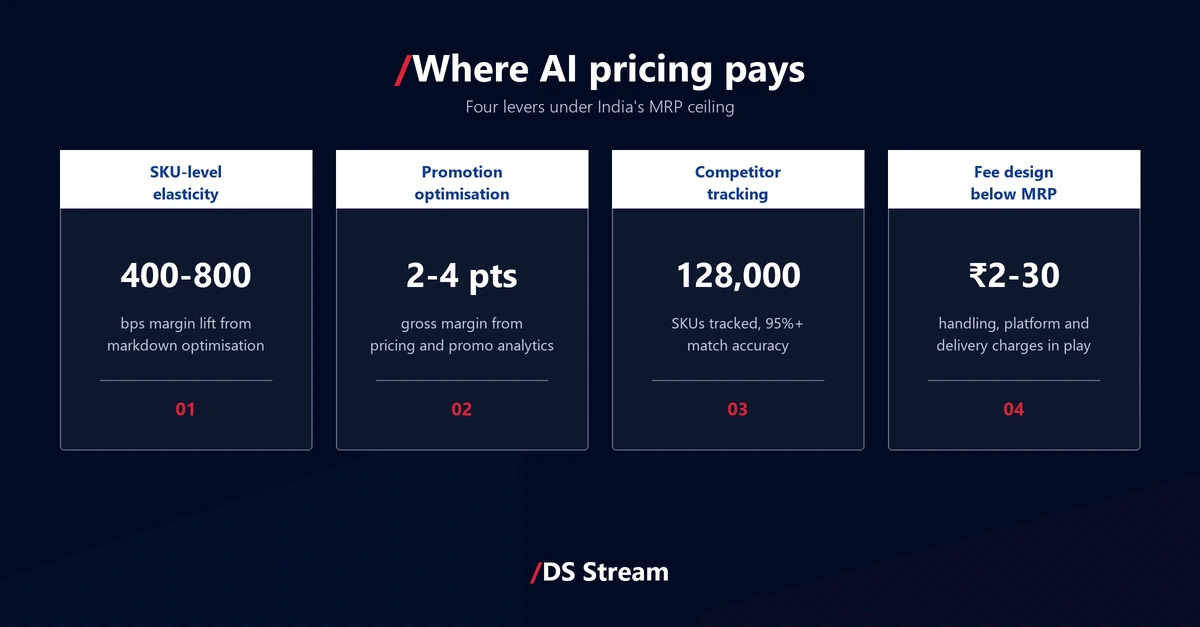
The core capability is price elasticity modelling at the level of a single SKU in a single store or dark store. Instead of one national list price, machine learning estimates how demand for a specific pack size shifts at each price point, in each location, at each hour, then recommends the price that protects margin without killing volume. McKinsey has put numbers on the upside: disciplined markdown optimisation can lift margin rates by 400 to 800 basis points, and integrated pricing and promotion analytics commonly deliver two to four points of gross margin. In a category where a strong operator earns low single-digit net margins, a few points is the difference between losing money and funding expansion.
Promotion is where Indian retail leaks the most value. Trade spend and discounts are often set by habit or by matching a rival, not by measured response. AI that models everyday price, promotional depth, and trade spend inside one demand model tends to beat teams that optimise each in isolation. The practical payoff is plain. Fewer blanket discounts that train shoppers to wait, and sharper promotions aimed at the packs and stores where a rupee off genuinely moves units.
Reading The Competition In Real Time
Modern trade and quick commerce move too fast for manual price checks. Vendors such as DataWeave crawl marketplaces and delivery apps continuously, matching identical products across sellers and claiming data accuracy above 95 percent. During Black Friday 2025 the firm tracked around 128,000 SKUs across Amazon India, Flipkart, and Myntra. Its reading of the market shows urban price gaps between quick commerce apps often sitting under five percent, while tier-two cities show wider variance. That tells a brand where it is genuinely competitive and where it is quietly leaving margin on the table or scaring off price-sensitive buyers.
The competitive pressure is not abstract. Amazon has signalled willingness to price products 15 to 20 percent below Blinkit and Instamart, funded by an India business that turns over more than 25,000 crore rupees a year. A quick commerce player cannot answer that with gut feel. It needs a system that watches rival prices, forecasts the volume and margin effect of matching or holding, and flags the specific SKUs worth defending.
The MRP And Perception Guardrails
Because the printed MRP caps the upside, Indian dynamic pricing is mostly a game of managing discounts and fees below that line, not surging above it. That is why platforms have shifted from headline product prices to a stack of charges. By 2025 Blinkit was adding handling fees of 4 to 11 rupees and delivery charges up to 30 rupees on orders above 199. Instamart layered platform fees of 2 to 10 rupees on top of handling charges near 10 rupees. Zepto went the other way and rolled back its rain surcharge. These experiments show both the appetite for flexible pricing and its limit. Shoppers accept paying a little more for speed, but the tolerance is thin, and a rival willing to undercut can expose it quickly.
Perception is the quieter risk. Charging two customers different amounts for the same basket, even legally below MRP, can read as unfair and travels fast on social media. An AI pricing programme in India has to treat consumer trust as a hard constraint in the model, not a footnote. Rules that cap how far personalised or time-based prices can diverge, and that keep the MRP visible and honoured, belong in the engineering, not just the marketing deck.
Getting Started Without Overbuilding
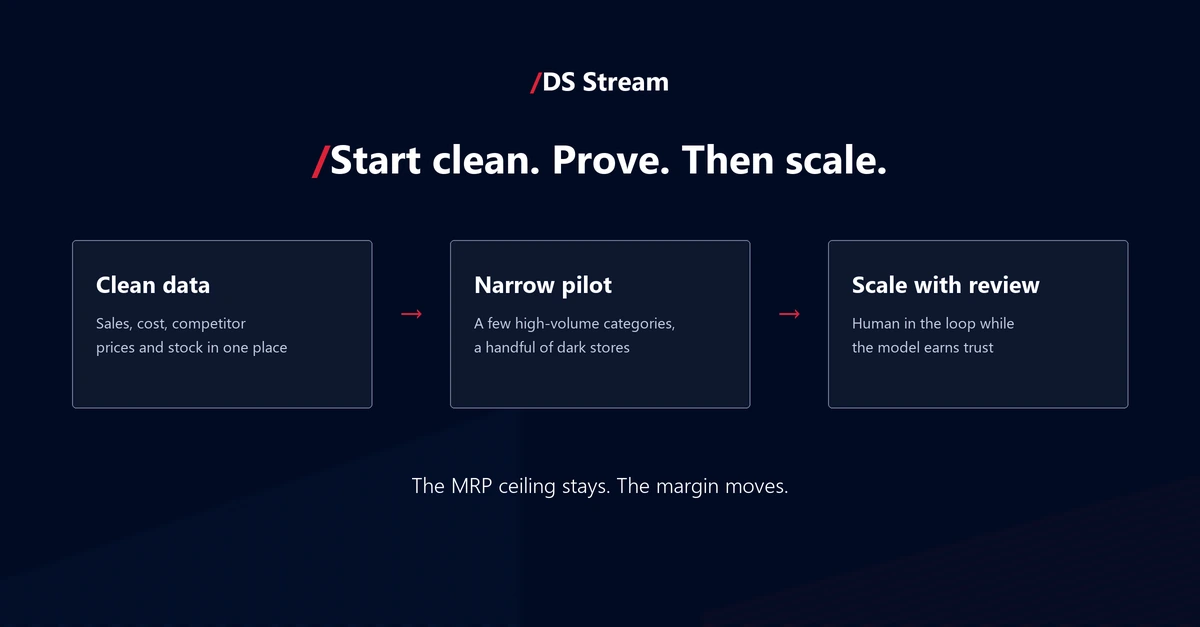
The sequence that works is unglamorous. Clean, unified data on sales, cost, competitor prices, and stock comes first, because an elasticity model trained on messy inputs will confidently recommend the wrong price. From there, a narrow pilot on a few high-volume categories in a handful of stores or dark stores proves the margin case before any national rollout. Human review stays in the loop while the model earns trust. The retailers that pull ahead are not the ones with the most elaborate algorithm, but the ones that connect a reliable data foundation to a pricing decision that respects both the math and the Indian shopper's sharp eye for MRP.
For FMCG and modern trade teams weighing this, the hard part is rarely the model itself. It is the data engineering and governance underneath it, which is where a focused partner can shorten the road.
Frequently Asked Questions
Is AI-driven dynamic pricing legal in India?
Yes, provided every recommended price stays at or below the printed Maximum Retail Price. Under the Legal Metrology Act and the Packaged Commodities Rules the MRP is a legal ceiling, so an algorithm may move a price down but never above it. The room to optimise sits in discount depth, promotional spend and the delivery or handling fees applied at checkout.
How does Indian dynamic pricing differ from Western surge pricing?
The direction of movement is reversed. A Western engine can raise a price when demand spikes; the MRP removes that option in India, so pricing decisions happen below the ceiling rather than above the list price. Quick commerce platforms have instead used separate charges, with handling fees of 4 to 11 rupees and delivery charges reaching 30 rupees on qualifying orders.
How much margin can AI pricing realistically add?
McKinsey puts disciplined markdown optimisation at 400 to 800 basis points of margin rate, with integrated pricing and promotion analytics typically worth two to four points of gross margin. For operators earning low single-digit net margins, that range decides whether growth is self-funding. Most of the recoverable value sits in promotions priced by habit or competitor matching rather than measured demand response.
What does a retailer need before starting an AI pricing pilot?
One reliable view of sales, cost, competitor prices and stock, before any modelling starts. Elasticity models fed with inconsistent inputs return confident but wrong recommendations. Limit the first test to high-volume categories in a small number of locations, keep a human reviewing the recommendations while the model earns trust, and code the guardrails, MRP compliance and a cap on price divergence, into the engine itself.
Sources
- McKinsey - How retailers can drive profitable growth through dynamic pricing
- McKinsey - Pricing and promotions: The analytics opportunity
- DataWeave - The State of Quick Commerce in India 2025
- Storyboard18 - Blinkit, Zepto, Instamart raise fees as quick commerce goes mainstream
- Finnovate - Quick Commerce in India: Why Pricing Could Decide the Winners
- Lawyered - What is MRP and How Does It Work

