Meta description: In 2026, AI in India’s quick commerce and dark store ecosystem is redefining how FMCG and retail leaders think about assortment, pricing, and on-demand fulfilment, yet it is still missing from most global AI retail conversations.
India’s quick commerce boom: the missing piece in AI retail debates
If you follow global discussions about AI in retail and FMCG, the spotlight usually falls on US and European grocery chains, fashion marketplaces, or big-box retailers. Meanwhile, one of the most dynamic AI laboratories in retail is almost absent from that conversation: India’s quick commerce (q-commerce) and dark store ecosystem.
By 2026, India’s q-commerce players have turned 10–30 minutes delivery from a novelty into a default customer expectation in major metros. India’s quick commerce market has scaled to $6–7 billion in GMV, growing at double digit CAGR, and now accounts for nearly one third of metro grocery spending in cities like Bengaluru, Mumbai, and Delhi NCR. Platforms such as Blinkit, Zepto, and Swiggy Instamart together handle over 1.4–1.6 million orders per day, reflecting both high frequency and dense demand signals. At the heart of this model are dark stores, compact, highly localized fulfilment centres embedded inside urban neighborhoods. As of early 2026, India has 3,000+ active dark stores, with rapid expansion continuing across Tier 1 and Tier 2 cities. These stores now carry a significant share of everyday baskets: fresh produce, staples, snacks, personal care, OTC pharma, and impulse categories.

For global FMCG and retail decision makers, this is not just a new channel. It is one of the most data-rich and operationally demanding retail environments where AI can be plugged into. Industry analyses show that stockouts in q commerce lead to nearly 2× higher ranking penalties than traditional e commerce, and even a 5% serviceability dip can materially impact share, making real time analytics and AI driven execution non negotiable. Ignoring AI in India’s quick commerce today is like ignoring search data in the early days of e-commerce. For organizations willing to engage with it seriously, India’s q commerce landscape is not a peripheral experiment, but a front row view into the future of data driven retail execution.

What makes India’s quick commerce uniquely suited for AI
India’s quick commerce and dark stores are not just “another version of online grocery”. They combine several characteristics that make AI not just attractive, but almost mandatory:
Extreme service promises: 10–20 minute delivery windows leave almost no margin for human guesswork in inventory, picking or routing.
Hyper-local variation: Demand, price sensitivity, and brand preferences can change every few kilometers, between apartment complexes, student districts, or mixed-income areas.
Small, frequent baskets: Average order values are often lower than in weekly grocery trips, which makes cost-to-serve and basket economics highly sensitive to assortment and pricing.
Dense operational networks: A single city can have dozens of dark stores and hundreds of riders, with huge combinatorial complexity.
These conditions are extremely difficult to manage with traditional rules, static planograms, and manual forecasting. They are, however, almost perfectly suited to AI systems that can learn patterns, optimize trade-offs, and adapt in near real time.
Where AI moves the needle in dark store operations
For India’s q-commerce operators, AI is no longer about abstract "innovation". It is about unit economics, SLAs, and market share.
There are five domains where AI already makes (or can make) a step-change difference:
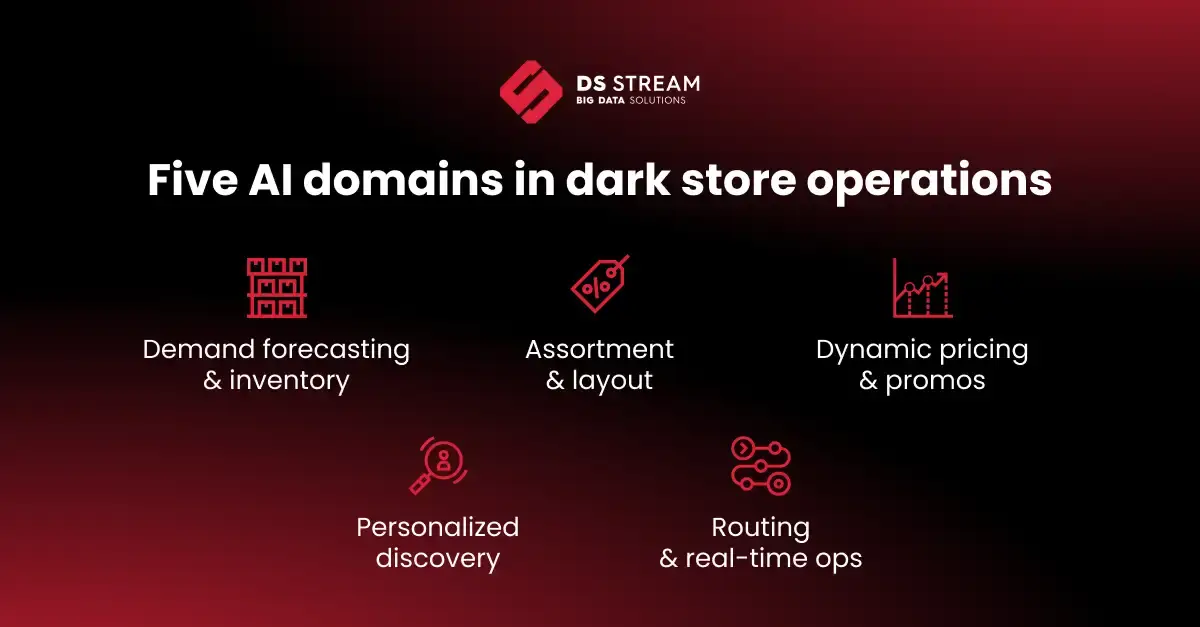
Demand forecasting and inventory planning: Store-level and even neighborhood-level forecasts based on real-time signals: weather, local events, paydays, holidays, and historical purchase behaviour. Dynamic safety stocks per SKU and per dark store, reducing both stock-outs and waste (especially for fresh and chilled categories).
Assortment and layout optimization: AI models that continuously test and refine which SKUs deserve space in each micro-market, rather than deploying a single national assortment. Heatmaps and route simulations that redesign shelf and bin layouts to minimize picker travel time and errors.
Dynamic pricing and promo effectiveness: Elasticity models that understand how shoppers in a specific catchment react to small price moves. AI that evaluates the true incremental value of promotions, instead of blunt discounting that erodes margin.
Personalized discovery in the app: Recommendations tuned not only to the user but also to the mission: “top-up milk”, “late-night snacks”, “urgent medicine”. AI-driven search and navigation that surface the right products in 1–2 taps, critical on small screens and rushed journeys.
Routing and real-time operations: Algorithms that assign orders to dark stores, pickers and riders to minimize promised vs. actual delivery gaps. Real-time adjustment to traffic, rain, and surge demand, without manual firefighting on control room screens.
When these systems work together, you do not just get a slightly more efficient operation. You get a structurally different cost and service curve than competitors relying on spreadsheets and intuition.
Why this matters for global FMCG and retail leaders
From a global FMCG or retail headquarters perspective, India’s AI-driven quick commerce is much more than a local innovation story. It is a preview of what happens when three forces collide: on-demand expectations, dense urban networks, and data-native consumers.
For FMCG brands, AI in India’s quick commerce changes at least four things:
The definition of “the shelf”: In dark stores, the shelf is not a fixed physical bay. It is a dynamic combination of in-store location, app visibility, and eligibility for fast delivery. AI decides who wins that shelf, hour by hour.
Measuring availability: On-shelf availability in a supermarket is hard to track. In quick commerce, AI can expose near-real-time fill rates at SKU x pin code level, and link them directly to lost sales.
Trade investment: Instead of generic trade promotions, brands can co-fund AI-driven micro-campaigns targeted at specific missions, cohorts, or micro-markets where they are underweight.
Innovation feedback loop: Q-commerce provides high-frequency, granular data on how new SKUs perform in different missions, shortening the learn–iterate cycle for NPD.
For global retailers outside India, the lesson is equally important: if AI can manage the volatility and complexity of Indian quick commerce, it can absolutely transform your own last-mile and convenience formats.
Why AI in India’s quick commerce is still under-discussed
Given this potential, why is AI in India’s quick commerce still a side note in most global reports on “AI in retail”?
There are several reasons:
Narrative bias: Western markets dominate analyst coverage and conference agendas. Case studies tend to focus on familiar banners, not on emerging market innovators.
Fragmented ecosystem: India’s quick commerce players are fast-moving, often private, and less transparent with their data and roadmaps than listed global retailers.
Language and proximity: Many of the most interesting experiments happen in product and ops teams in Bengaluru, Gurugram or Mumbai, far from global FMCG headquarters and outside their usual partner networks.
The result is that AI in dark stores and quick commerce is treated as a niche Indian success story, rather than a strategic blueprint for the next decade of convenience retail globally.
Barriers that still hold AI back in q-commerce
This does not mean AI adoption in India’s quick commerce is easy or complete. There are real barriers that global leaders should understand, both as risks and as collaboration opportunities.
Data quality and integration: Transactional data, app analytics, supply chain systems and rider apps often sit in separate silos, with inconsistent taxonomy and missing fields.
Talent and ownership: AI initiatives can be scattered between central data science, product, and operations teams, with no single P&L owner.
Model trust and explainability: Category managers and city ops leads may resist AI recommendations if they cannot connect them to their lived reality on the ground.
Vendor sprawl: It is easy to end up with a patchwork of tools for forecasting, recommendations, routing, and promotions, without a coherent architecture.
For FMCG and retail decision makers, recognizing these obstacles is key. It highlights where you can bring capabilities, co-invest, or structure partnerships that de-risk AI adoption for your quick commerce partners.
A Practical Roadmap: How Global FMCG and Retail Can Engage
To unlock real value, global FMCG and retail organizations need to look at India’s AI driven quick commerce not just as a sales channel, but as an innovation lab they actively help shape. The opportunity lies in moving from passive participation to deliberate collaboration.
A practical engagement roadmap could look like this:
1. Assess the AI maturity of key partners
Start by understanding where your quick commerce partners are already strong, and where they struggle.
- Which AI capabilities are mature today: demand forecasting, personalization, routing, dynamic pricing?
- Where do teams still rely on manual workarounds, heuristics, or operational intuition?
This clarity helps anchor collaboration in reality rather than ambition.
2. Design joint pilots around real business questions
Effective pilots begin with commercial problems, not technology demos.
For FMCG teams, that might mean asking:
- In which micro markets are we under spaced versus true demand?
- Which shopping missions are we consistently failing to win?
For retailers, it could be:
- How do we improve dark store inventory turns by X% while simultaneously improving availability and service levels?
- Clear questions create focus, and measurable outcomes.
3. Co build shared data products, not one off reports
The biggest gains come from reusable, trusted data assets. For example, a q commerce demand radar that translates raw transaction data into insights by mission, pin code, and price tier or a joint AI model that predicts promotional uplift by cohort, built with transparent logic that both sides understand and trust.
These shared products become the backbone for scaling decisions.
4. Align incentives with AI driven outcomes
As AI maturity increases, commercial models need to evolve. This means moving beyond generic, volume based trade deals toward incentives that reward better availability, higher share of mission, improved inventory productivity, or stronger customer satisfaction, outcomes directly influenced by AI enabled execution.
5. Build AI literacy across commercial teams
Finally, AI only delivers value when people know how to engage with it. Category managers, key account teams, and trade marketers should be able to ask the right questions of AI, interpret outputs critically, and challenge recommendations intelligently, not just consume dashboards passively.
The Opportunity Window: 2026–2028
The next two to three years will be decisive. India’s quick commerce and dark store ecosystem is at a stage where the rules are still being written.
Data foundations are rapidly maturing, but they are not yet frozen into rigid legacy architectures. Competitive positions remain fluid, and the application of AI, whether in assortment logic, inventory placement, or execution speed, can reshape the economics of an entire city or category faster than most leaders expect. At the same time, global FMCG and retail organizations are actively deciding where to place their largest AI, data, and retail media bets across Asia.
For global decision makers, this creates a clear fork in the road. One path is to continue treating India’s quick commerce as a tactical, promotion heavy channel, doing the basics, pushing short term offers, and chasing incremental share. The other is to treat it as a strategic AI playground: a live environment to learn how algorithmic assortment, dark store optimization, hyper local demand sensing, and AI driven retail media will actually work at scale, insights that will shape retail execution everywhere over the next five years.
Only the second path builds a durable competitive advantage.
Conclusion: Put AI in India’s Quick Commerce at the Centre of Your Strategy
AI in India’s quick commerce and dark store ecosystem is not a sideshow to the “real” story of AI in retail. It is where some of the hardest problems in modern retail are already being solved in production, extreme service level expectations, dense urban fulfilment networks, volatile demand patterns, and hyper local consumer behaviour.
For global FMCG and retail leaders, the implication is straightforward: if your AI in retail roadmap does not explicitly include India’s quick commerce, it is incomplete.
The starting point is not technology for its own sake. It is understanding where AI already operates inside your partners’ dark stores and consumer apps today. From there, the opportunity is to co design pilots, shared data products, and incentive models that align AI outcomes with measurable, mutual business value.
Those who lean into this now will do more than participate in India’s rapid quick commerce growth. They will develop the AI playbooks that define convenience retail globally over the next decade.
References:
[1]: SW Cybernetics (2026). "State of Q-commerce in India 2026" Retrieved from https://www.ey.com/en_in/insights/consulting/global-capability-centers/india-s-gccs-are-leading-the-shift-to-intelligent-ai-native-enterprises
[2]: Tech RT / Internet (2026). "Quick Commerce Statistics 2026: Growth, Trends, and Insights" Retrieved from https://techrt.com/quick-commerce-statistics/


.webp)