Customizing AI Agents for CPG Field Sales Success

Magdalena Okrzeja
Magdalena Okrzeja
December 10, 2025
•
4 min read
Loading the Elevenlabs Text to Speech AudioNative Player...

n today’s fast-paced consumer packaged goods (CPG) industry, AI agents have become essential to optimizing field sales operations. The AI-powered sales ecosystem seamlessly collects diverse data sources, processes them into actionable insights via specialized AI agents, and delivers support through intuitive user interfaces. This integrated system enhances decision-making, operational efficiency, and overall sales effectiveness for field teams.

Data Sources and Processing

AI solutions aggregate data from internal documents (e.g., PDFs, DOCX), and systems such as road planning, task management, sales performance KPIs, and dashboards. Additionally, external store-level data and market analytics are ingested. Using embedding techniques and centralized cloud data warehouses like e.g. Google BigQuery, these datasets are enriched, integrated, and made searchable - creating a robust intelligence backbone for AI agents.

Specialized AI Agents for Sales Functions

Sales Planning Agent

‍
How it works:
Analyzes historical sales records and retailer point-of-sale (POS) data, leveraging SKU-level volumes, trends, and seasonality from data warehouses. It incorporates syndicated market analytics and competitive intelligence, and processes forecasts from predictive models augmented by external economic indicators and promotional calendars. The outcome is realistic sales targets and optimized product portfolios.

Technical build:
This agent uses Retrieval-Augmented Generation (RAG) to combine historical sales with real-time market signals. Built on frameworks like Google’s Agent Development Kit (ADK), it leverages Large Language Models (LLMs) for reasoning across complex rules, orchestrating workflows that dynamically update sales targets. Data is processed in read-optimized database Google BigQuery for scalable analytics.

Route Support Agent

‍
How it works:
Optimizes delivery and sales routes based on internal geospatial data, CRM/ERP store visit logs, and real-time traffic conditions. It sequences visits for maximum efficiency and incorporates external data such as stock availability and ongoing promotions to adapt routes for improved productivity and on-shelf availability.

Technical build:
Powered by geospatial and internal systems, it uses algorithmic route optimization models. Using an AI agentic framework (e.g., ADK), it manages task orchestration, remembers prior routes, and adapts visit plans in real-time to minimize travel time and maximize field impact.

Stock Planning Agent

‍
How it works:
Focuses on inventory KPIs from warehouse management and retail scanner data. Integrates demand forecasts from sales planning and live replenishment data from distribution centers. Market analytics anticipate demand spikes and product cannibalization risks, enabling dynamic stock allocation and minimizing out-of-stocks.

Technical build:
Implements machine learning models hosted on Google Vertex AI to predict demand fluctuations and stockout risks. RAG techniques ground predictions in real-time supply chain data. Via agentic framework like Google’s ADK, it automates stock prioritization workflows responsive to sales velocity, market conditions, and promotion schedules.

Training & Performance Agent

‍
How it works:
Monitors sales performance dashboards, call recordings, and training records. Collects real-time feedback through AI-powered voice or chat channels during store visits. Enriches insights with historical coaching data and peer benchmarks to deliver personalized learning and performance management.

Technical build:
Utilizes LLMs through ADK for skill gap analysis and personalized content delivery. RAG supports informed chatbot interaction grounded in coaching manuals and sales training materials. Session and memory management ensure continuity and effective tracking of individual progress.

Promotion & POP Agent

‍
How it works:
Analyzes historical promotion success metrics, uplift data from POS during campaign periods, and trade marketing schedules. Assesses retailer compliance through planogram audits and shelf compliance via computer vision. Pulls consumer sentiment and competitor promotion data from social media and research platforms for comprehensive promotional insights.

Technical build:
Synthesizes data using computer vision analytics and integrates sentiment analysis data based on acquired data sets from external market research or internal sentiment analytics. Built with ADK, utilizes episodic memory to recall past campaign outcomes, informing optimized promotion planning and real-time execution adjustments.

360 Analytics Agent

‍
How it works:
Aggregates data spanning sales, inventory, market trends, consumer behavior, and competitor activity. Applies advanced data fusion and ensemble machine learning to provide holistic insights. Supports strategic decision-making, anomaly detection, and cross-departmental analytics via interactive dashboards and conversational AI interfaces.

Technical build:
Leverages cloud AI platforms for multi-source data integration and machine learning. ADK orchestrates multi-agent workflows, maintains long-term memory, and delivers insights through AI-powered conversational dashboards designed for executive users.

Technological Backbone

These AI agents are typically built using tools like Google’s Agent Development Kit (ADK), an open-source framework for enterprise-grade AI agent development. ADK integrates Large Language Models like Google Gemini, orchestrates complex workflows, and persistently manages conversation and task states. The data foundation relies on cloud data warehouses such as Google BigQuery, consolidating, and processing various data sources. Retrieval-Augmented Generation (RAG) technology ensures agent responses are grounded in fresh, relevant enterprise data. Robust API integrations, session memory, and artifact management within ADK facilitate scalable, flexible deployments tailored to unique CPG sales processes.

User Interface Layer: Delivering AI Insights Where They Matter

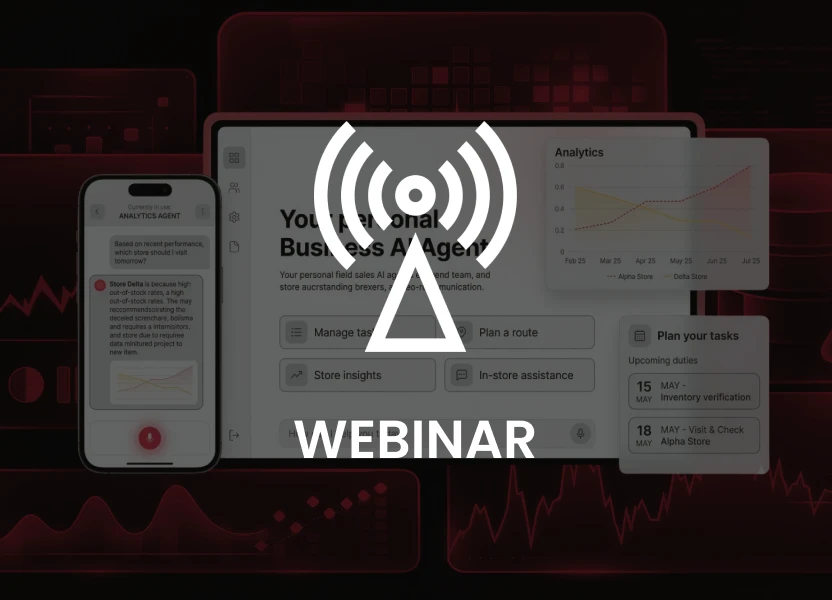
A crucial component of any successful AI agent solution for CPG field sales is the user interface layer, which bridges sophisticated AI capabilities with real-world field operations. This layer ensures recommendations, insights, and automated actions are delivered precisely where and how sales teams need them. AI-powered assistants are commonly provided through intuitive mobile apps, granting field reps access to actionable insights even offline. Managers gain from AI-driven dashboards on desktops or tablets that visualize analytics and track team performance in real time. Furthermore, conversational AI interfaces, such as embedded AI chats - allow reps and managers to ask questions, request tasks, or automate workflows naturally within a familiar chat environment. To minimize adoption friction and boost engagement, these AI chats can integrate seamlessly into existing organizational communication platforms like Microsoft Teams, Slack, or Google Chat. Leveraging cross-platform interoperability solutions, these integrated chats deliver AI insights where users already collaborate, reducing barriers to use and accelerating training. By tailoring UI/UX for each role and embedding AI seamlessly into daily workflows, organizations maximize adoption, elevate productivity, and transform AI investments into tangible sales success.

Together, these AI agents convert complex, data-rich sales ecosystems into streamlined, intelligent workflows customized to each CPG field sales team’s environment and objectives. This precise, data-driven tuning delivers actionable insights across the sales journey, empowering sales reps and managers to optimize performance, reduce inefficiencies, and drive sustainable revenue growth.

‍

Share this post
Generative AI
Magdalena Okrzeja
MORE POSTS BY THIS AUTHOR
Magdalena Okrzeja

Curious how we can support your business?

TALK TO US